
REVIEW · MOSTAR TOURS
Mostar Shelters tour in Mostar
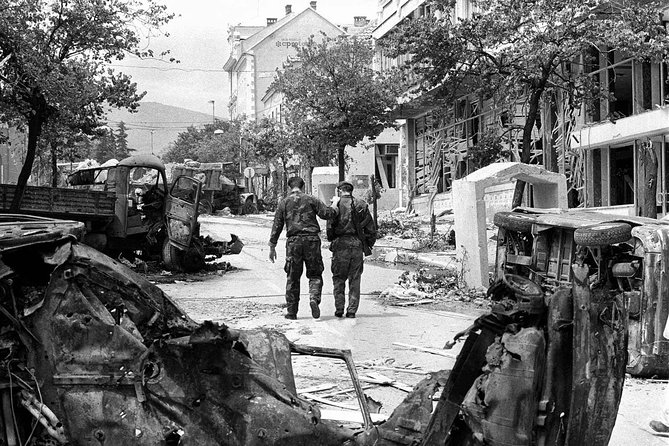
Mostar’s scars tell a difficult story. The Mostar Shelters tour brings you beyond the postcard views of Stari Most and into the city’s wartime past, using a mix of short walks, vehicle travel, photographs, and personal accounts. I like the access to artillery positions, trench lines, and parts of the urban front line, and I also like the chance to see Mostar from the mountain cross above the city. The main consideration is emotional: this is a serious tour about the 1992 to 1995 war, not a light sightseeing outing.
The tour is especially strong because of its local guides, including Miran and Dario, who explain difficult events in a direct but inviting way. I also like the value at $41.20 per person, particularly since hotel pickup is included at selected hotels and the group is limited to 16 people. Allow extra time, though, since the advertised two hours can become closer to three.
In This Review
- Key points to know before booking
- Why this tour adds another side to Mostar
- Starting at Onešćukova Street at 5 p.m.
- The vehicle portion: covering Mostar’s wartime ground
- Artillery positions and trench lines
- Mostar’s urban front line
- The mountain cross and the view over Mostar
- Guides who make difficult history approachable
- Is $41.20 good value?
- Who should book the Mostar Shelters tour?
- My recommendation for Mostar
- FAQ
- Where does the Mostar Shelters tour start?
- What time does the tour begin?
- How long does the tour last?
- Does the tour include hotel pickup?
- What is included in the price?
- Are food and drinks included?
- How many people can join the tour?
Key points to know before booking
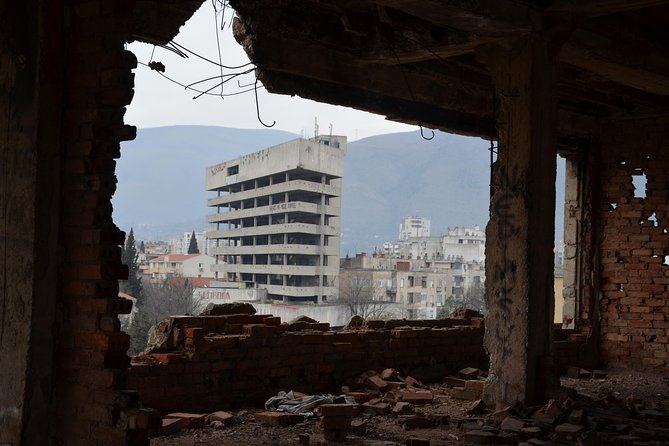
- The tour visits real wartime locations: Expect artillery positions, trench lines, damaged urban areas, and other sites connected to Mostar’s siege.
- It mixes driving with short walks: The van handles much of the distance, while brief walks bring you closer to key viewpoints and war sites.
- Miran and Dario are named guides: Their style combines historical explanation, personal stories, photographs, and real footage.
- The mountain cross offers a different view: The high viewpoint gives you a useful sense of Mostar’s position and the scale of the city.
- The subject is direct and emotional: Questions are welcomed, and no topic is treated as off limits.
- The small group matters: With a maximum of 16 people, you have a better chance to hear the guide and ask questions.
Why this tour adds another side to Mostar
Mostar is easy to experience as a beautiful old town with a famous bridge, stone lanes, cafés, and souvenir shops. That version of the city is real, but it is only part of the picture. Bullet holes, burned buildings, and damaged structures still point to the Bosnian War, and the Mostar Shelters tour helps you understand what those marks mean.
I find this kind of tour valuable because war damage can become invisible after a while. You see a pockmarked wall, take a photograph, and move on without knowing who used the building, who lived there, or how close the fighting came. Here, the guide connects the physical remains with the events that shaped them.
The focus is Mostar’s particular wartime story. You are not simply given a broad lesson about the breakup of Yugoslavia. The tour explains the city’s front lines, military positions, shelters, and the way ordinary people lived during the conflict. That local focus gives the experience more weight than a standard history talk.
The tone is serious, but it is not designed to shut down conversation. The guide explains difficult subjects in a way that encourages you to ask questions. That is useful if you know little about the war, but it also works if you already understand the wider conflict and want to know what happened in Mostar itself.
A few more of this kind worth a look:
- From Dubrovnik: Mostar and Kravica Waterfall Day Trip
★ 4.7 · 4,709 reviews - Dubrovnik: Kravica Waterfalls, Mostar and Pocitelj Day Trip
★ 4.5 · 3,045 reviews - Dubrovnik: Mostar & Kravica Waterfalls Day Trip
★ 4.8 · 1,970 reviews
Starting at Onešćukova Street at 5 p.m.
The listed meeting point is Onešćukova 32, Mostar 88000, with a start time of 5 p.m. The tour ends back at the same meeting point. Selected hotels can receive pickup, so check that detail when booking rather than assuming every hotel is included.
An afternoon start works well in Mostar. You can spend the earlier part of the day around the Old Town, then turn to the war history when the streets are less about sightseeing and more about understanding the city. Since the tour may last between two and three hours, keep the rest of your evening flexible.
The meeting point is near public transportation, which helps if you are not staying nearby. Confirmation is provided when you book, and at least two people are required for a booking. The group limit is 16, small enough for a more personal explanation without making this a private tour.
The vehicle portion: covering Mostar’s wartime ground
This is a half-driving, half-walking experience in its overall design, though the driving portion appears to cover much of the tour. That is a practical advantage in Mostar, since the important sites are not all concentrated around the Old Bridge.
The vehicle lets you move between locations without spending the entire evening walking through the city. Along the way, the guide provides live commentary and explains how the war affected different parts of Mostar. This helps you connect the center with the surrounding positions and viewpoints.
A van also makes it possible to reach locations that would be inconvenient to visit alone. One account describes a group of four being driven between stops, with short walks along the way. The maximum group size is 16, so the exact vehicle and atmosphere can vary, but you should expect a shared tour rather than a private ride.
The tradeoff is that you will not spend every minute exploring on foot. If you prefer a slow walking tour with time to examine each street, this may feel fast in places. I see the driving as a sensible part of the design, though, because the tour is trying to explain a whole city’s wartime geography in one evening.
Artillery positions and trench lines
The tour visits artillery positions and trench lines connected to the fighting around Mostar. These are not just abstract points on a map. They help explain where the attacks came from and why certain buildings and neighborhoods were hit.
The guide uses photographs and real footage to support the explanations. That visual material matters because the city has changed since the war, and some areas may not immediately look as they did in the 1990s. Seeing earlier images alongside the present-day setting helps you understand the scale of the destruction and the work of rebuilding.
The stops also give you a chance to ask specific questions. The tour description promises that no subject is taboo, and the accounts of the experience repeatedly praise the willingness of the guides to explain difficult points in detail. If you have wondered about the bullet holes in central buildings or the burned houses around Mostar, this is the time to ask.
Expect short walks rather than a long hike. Still, you should wear comfortable shoes and be prepared to move between the vehicle and outdoor locations. The supplied information does not describe the walking surfaces or exact distances, so anyone with particular mobility concerns should confirm those details before booking.
Something different, still around Mostar:
- Dubrovnik: Mostar and Kravice Waterfalls Small-Group Tour
★ 4.8 · 1,194 reviews - From Split or Trogir: Mostar & Kravica Waterfall Group Tour
★ 4.7 · 929 reviews - From Dubrovnik: Mostar and Medjugorje Full-Day Tour
★ 4.4 · 898 reviews - Discover Herzegovina Day Tour from Mostar: Kravice Waterfalls, Blagaj, Počitelj
★ 5.0 · 742 reviews
Mostar’s urban front line
The urban front line is one of the most useful parts of the experience because it places the war inside the city you are already visiting. The Old Town’s beauty can make the conflict feel distant, but damaged buildings and street-level evidence show how closely the fighting affected daily life.
The guide explains how people lived through that period, then discusses what happened to them later. That second part is important. A tour about war can become a list of battles and dates, but the human consequences continue after the shooting stops. The personal stories told by the guides give the subject a more direct human scale.
Miran is praised for explaining the material with both feeling and care, while Dario is noted for using personal stories to make complex events easier to follow. The guide you receive may be Miran, Dario, or another member of the operation, so do not book solely on the promise of one named person. Still, the repeated mention of these guides suggests that the quality of the tour depends strongly on who leads it.
You will likely come away with a clearer answer to a simple question: how did ordinary people live here during the war? That makes this more than a tour of ruins. It is an attempt to explain how a functioning city endured a conflict that reached homes, streets, and public buildings.
The mountain cross and the view over Mostar
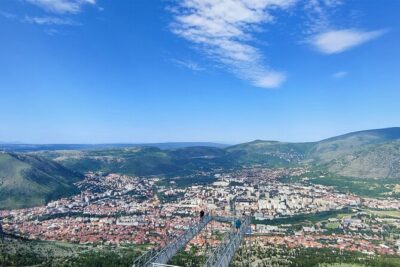
One stop takes you to the mountain cross above Mostar. The view is described as beautiful, but its value is not only scenic. From above, you can better understand the city’s shape and the relationship between the central neighborhoods, surrounding hills, and wartime positions.
This is where the tour’s geography becomes easier to grasp. From street level, it can be hard to understand why a particular ridge or hillside mattered. A high viewpoint gives you a wider picture, and the guide can connect what you see with the military history being discussed.
The viewpoint also provides a pause in an emotionally demanding tour. You are still dealing with serious history, but the open view gives you a moment to process it. Bring suitable clothing for the conditions, since the experience includes outdoor stops and the tour takes place in the evening. Exact weather guidance is not provided, so use ordinary good judgment for the date of your visit.
Guides who make difficult history approachable
The guide is the heart of this experience. A war tour can easily become cold, political, or overloaded with dates. The best moments here appear to come from the way the guides combine facts with photographs, footage, and personal accounts.
Miran is described as encouraging questions and explaining the subject with heart and knowledge. Dario is praised for speaking about the war for nearly three hours without making the discussion feel heavy or dull. That is a difficult balance, especially when the subject includes destruction, displacement, and loss.
I appreciate that the tour does not appear to avoid uncomfortable questions. Mostar’s wartime history is complicated, and a polished version would not help you understand it. You should expect a direct presentation, but also one intended to be accessible to people who have never experienced war firsthand.
The experience is also useful if you book it alongside the Death of Yugoslavia tour offered by the same company. The two subjects can fit together without being identical: one gives a broader regional setting, while Mostar Shelters concentrates on the city’s own wartime experience. If you only have time for one, Mostar Shelters is the more place-specific choice.
Is $41.20 good value?
At $41.20 per person, the tour offers solid value if you want more than a general city walk. The price includes a professional guide, live commentary during the drive, and hotel pickup from selected hotels. Food and drinks are not included, but that is not a major issue for a two to three-hour evening activity.
The strongest value comes from access. You could walk around Mostar and notice damaged buildings on your own, but you would not easily reach the artillery positions, trench lines, and mountain viewpoint while also receiving a connected explanation. The vehicle saves time and gives the tour a wider reach.
A small group of up to 16 people is another positive. This is not necessarily an intimate private experience, but it should be easier to follow than a large coach tour. You also have a better chance to ask questions, which matters on a complicated subject.
The price may feel less attractive if you are looking only for scenic sightseeing. The emotional and historical focus is the point, and much of the value depends on your interest in understanding Mostar’s recent past. I would not choose this as a casual filler between cafés and photographs. I would choose it because I want context.
Who should book the Mostar Shelters tour?
I recommend this tour for adults and older children who can handle serious wartime material. Children must be accompanied by an adult, and the activity information says most people can participate. The tour does not list a special fitness requirement, but you should be comfortable with short walks and getting in and out of a vehicle.
It suits you best if you:
- Want to understand the bullet holes and burned buildings around Mostar
- Prefer local explanation to a self-guided visit
- Are interested in the Bosnian War and Mostar’s siege
- Like a tour that includes both driving and outdoor stops
- Want a small-group activity with time for questions
- Have already seen Stari Most and want another side of the city
It may not suit you if you want a cheerful evening outing, a relaxed food tour, or a purely architectural walk. The subject is heavy, and the guides speak about it with obvious personal feeling. That is a strength for many people, but you should know the mood before you reserve.
Free cancellation is available if you cancel at least 24 hours before the local start time. Changes or cancellations inside that window are not accepted for a refund.
My recommendation for Mostar
I would book the Mostar Shelters tour if I wanted to understand Mostar rather than simply photograph it. The combination of wartime sites, vehicle access, short walks, high views, photographs, footage, and local storytelling gives you a fuller picture of the city.
The best reason to go is the explanation of how people lived through the war and what followed. The best practical reasons are the included selected-hotel pickup, repeated departure availability during the day as advertised, and the manageable group size.
Go with an open mind, comfortable shoes, and enough time for the tour to run toward three hours. If you can spare the $41.20 and want history told at street level, this is one of the most worthwhile ways to spend an evening in Mostar.
FAQ
Where does the Mostar Shelters tour start?
The tour starts at Onešćukova 32, Mostar 88000, Bosnia and Herzegovina.
What time does the tour begin?
The listed start time is 5 p.m.
How long does the tour last?
The tour is advertised at approximately two hours, though the experience may take between two and three hours.
Does the tour include hotel pickup?
Hotel pickup is included from selected hotels only. You should confirm that your accommodation qualifies when booking.
What is included in the price?
The price includes a professional guide, hotel pickup from selected hotels, and live commentary on board.
Are food and drinks included?
No. Food and drinks are not included.
How many people can join the tour?
The maximum group size is 16 people, and a minimum of two people per booking is required.
Just added around Mostar
- Private Day trip to Medjugorje from Split or Dubrovnik★ 5.0 · 3 reviews
- From Dubrovnik: Sarajevo and Mostar Private Full-Day Tour★ 4.7 · 3 reviews
- From Dubrovnik to Mostar and Kravice waterfalls★ 3.5 · 3 reviews
- From Dubrovnik: Medjugorje Private Day Tour★ 4.3 · 3 reviews
- Pocitelj City Tour★ 4.5 · 3 reviews
- Mystical Sutjeska National Park★ 5.0 · 3 reviews
- Mostar Guided Tour & Sweet Delights★ 5.0 · 3 reviews
- Private tour from Split to Dubrovnik via Mostar★ 5.0 · 3 reviews
Mostar Tours, compared.
Kravica Waterfalls, Mostar and Pocitelj Day Trip
Read our review →
Mostar and Kravice Waterfalls Small-Group Tour
Read our review →
Discover Herzegovina Day Tour from Mostar: Kravice Waterfalls, Blagaj, Počitelj
Read our review →
Browse the lists this tour appears in