
REVIEW · SARAJEVO TOURS
7 Days Balkan Tour Bosnia Croatia Montenegro Albania N.Macedonia
Five countries, one busy week. This private Balkan tour links Sarajevo, Mostar, Dubrovnik, Kotor, Tirana, Ohrid, and Skopje with an English-speaking driver-guide and local guides in several cities. I like the way the route mixes major sights with places such as Blagaj, Pocitelj, Konjic, and Kravice Falls. I also like the private format, which gives your group its own vehicle and schedule rather than placing you on a large coach.
The main drawback is the pace. You cover a lot of ground, cross several borders, and spend long stretches on the road. Summer heat and traffic can make the days tiring, especially in July, but the air-conditioned vehicle and four-star hotels help.
In This Review
- Five details that shape the experience
- What $2,013.49 buys you
- Sarajevo begins with many layers of history
- Konjic and Mostar follow the Neretva south
- Blagaj, Pocitelj, and Kravice Falls show another side of Herzegovina
- Dubrovnik and Montenegro pack two famous old towns together
- Shkoder and Tirana shift the mood in Albania
- Ohrid provides one of the gentler stops
- Skopje ends with two sides of the Vardar
- The private guiding is the strongest feature
- Who should book this seven-day route?
- Should you book Tour Mage?
- FAQ
- Where does the tour begin?
- How long is the tour?
- Which countries does the route visit?
- Are hotels included?
- Are meals included?
- Is the tour private?
Five details that shape the experience
- Sarajevo sets the tone: The first day combines Ottoman, Austro-Hungarian, Jewish, Catholic, Orthodox, and modern wartime history.
- A private vehicle keeps the route practical: Pickup is available anywhere in Sarajevo, and only your group takes part.
- The scenery changes quickly: You move from Sarajevo’s mountain setting to the Neretva Canyon, Adriatic coast, Montenegrin bays, Albanian cities, and Lake Ohrid.
- Local guides add depth: City tours are arranged in Sarajevo, Mostar, Dubrovnik, Kotor, Shkoder, Tirana, Ohrid, and Skopje.
- The price covers the major basics: Six nights in four-star hotels, six breakfasts, transport, guiding, taxes, and entrance to the Sarajevo War Tunnel and Kravice Falls are included.
- The schedule favors breadth over leisure: You see a remarkable number of places, but free time is often limited by road conditions and border crossings.
What $2,013.49 buys you
At $2,013.49 per person, this is not a budget tour. It becomes easier to judge once you look at what is bundled into the price: six nights of four-star accommodation, six breakfasts, an air-conditioned vehicle, an English-speaking driver or guide, local guides, entrance fees listed in the program, and taxes.
The private arrangement is the key value. You are not paying only for sightseeing. You are also paying for a driver who handles the long connections between countries, hotel transfers, and border crossings while your group travels together. A private week across five countries would be difficult to arrange independently, especially if you want local guides waiting in each major city.
Lunch and dinner are not included. That gives you freedom, but it also means you should budget separately for seven days of meals. The program also does not list every attraction as an included admission. The Sarajevo War Tunnel and Kravice Falls are specifically included, while places such as Gazi Husrev-beg Mosque and the Jewish Museum may require separate payment.
The best value comes if you want a guided overview rather than a slow, single-country holiday. If you prefer long mornings, extended museum visits, or several nights in each city, this route may feel too compressed.
Other trips around Sarajevo booked with this one:
- Sarajevo: Mostar, Konjic, Blagaj Tekke, Pocitelj & Waterfall
★ 4.9 · 1,335 reviews - Fall of Yugoslavia, Sarajevo War Tour with Tunnel of Hope Museum and Frontlines
★ 5.0 · 1,314 reviews - Sarajevo: Mostar, Konjic, Sufi House, Pocitelj & Kravice Falls
★ 5.0 · 1,179 reviews
Sarajevo begins with many layers of history
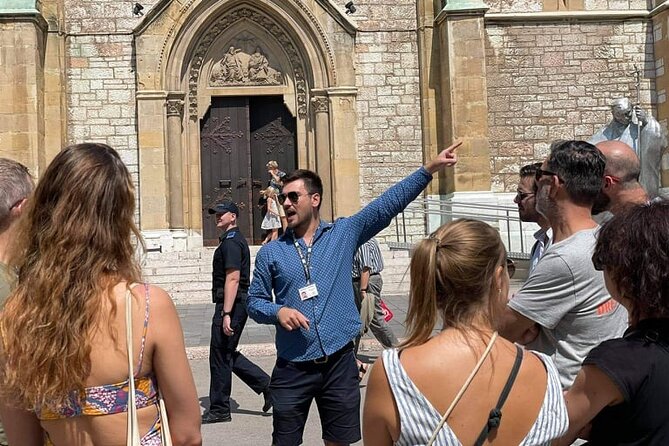
Your first day starts with pickup in Sarajevo and an introduction to the Old Town. The route begins near City Hall and continues through the craft streets toward Bascarsija Square, where the Sebilj fountain gives you an immediate sense of the Ottoman character of the city.
A short visit to Coppersmith Store Hidic adds a useful human detail. This is not just a walk past old buildings. You see the preserved coppersmith street and learn about a craft that has survived from Sarajevo’s Ottoman period.
At Gazi Husrev-beg Mosque, the guide explains the role of Gazi Husrev Bey, a major benefactor who funded the mosque, school, caravan hotel, covered market, and other buildings. The visit helps explain why Sarajevo’s historic center feels like a complete urban district rather than a collection of isolated monuments.
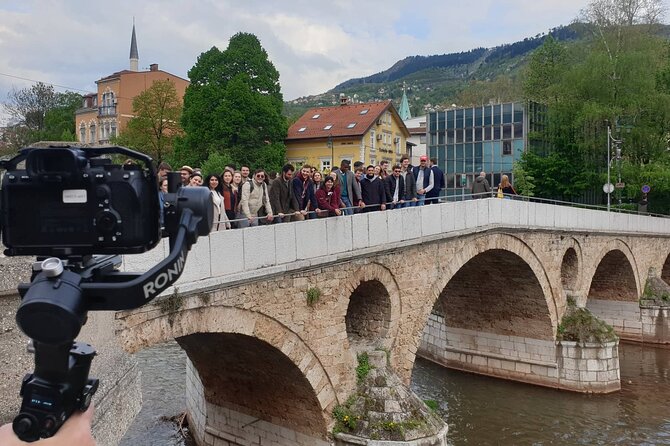
The walk then turns toward the Latin Bridge, linked to the assassination that helped trigger World War I. It is a small bridge with a very large place in European history. The Jewish Museum, housed in the former Old Jewish Temple, gives you a short introduction to Sarajevo’s Jewish heritage.
Within a small area, you also see the Cathedral of the Sacred Heart, the Markale Market, and the Serbian Orthodox Cathedral. The sequence matters. Sarajevo’s Old Town presents Muslim, Jewish, Catholic, and Orthodox traditions within walking distance. That mixture is one of the city’s most important lessons.
At Markale Market, the focus shifts to the Siege of Sarajevo, including the daily danger and the marketplace massacre. Later, a panoramic drive leads to the Sarajevo War Tunnel Museum. The tunnel was a vital wartime link during the siege, and the visit gives the modern part of the city’s story a physical setting.
This is a demanding first day intellectually. You are not simply checking off monuments. You are hearing about faith, empire, war, survival, and the city’s complicated identity. Wear comfortable shoes and expect the day to feel full even though several stops last only 10 to 15 minutes.
Konjic and Mostar follow the Neretva south
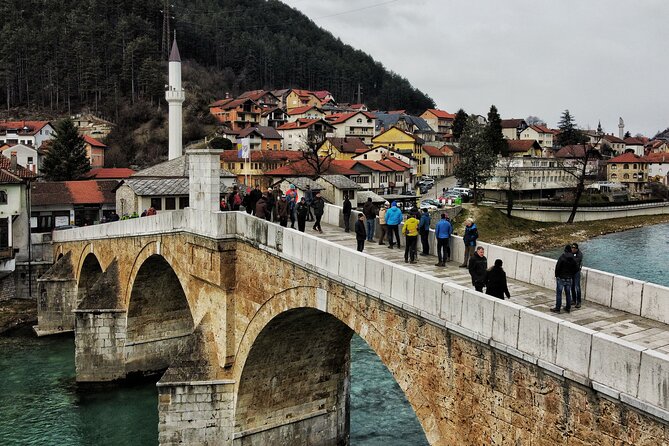
After breakfast, the vehicle leaves Sarajevo for Herzegovina. Konjic is the first stop, reached after about an hour. Its Ottoman stone bridge crosses the upper Neretva River and offers a brief introduction to the region’s architecture and river valleys.
The road toward Mostar is one of the visual rewards of the trip. The route follows Jablanico Lake and the Neretva Canyon, so the drive itself becomes part of the sightseeing. You should keep your camera ready, but do not expect a leisurely photo stop at every scenic point.
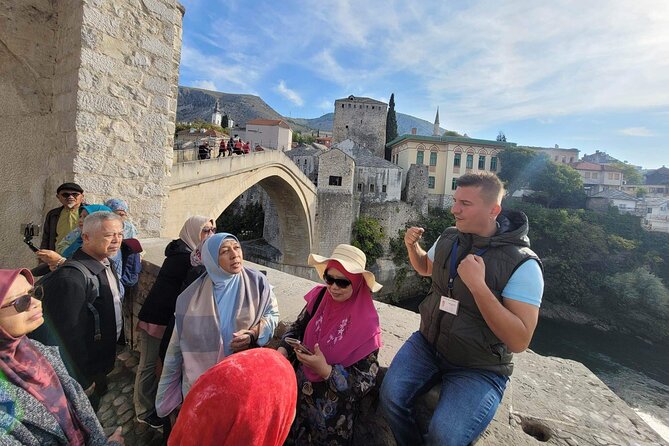
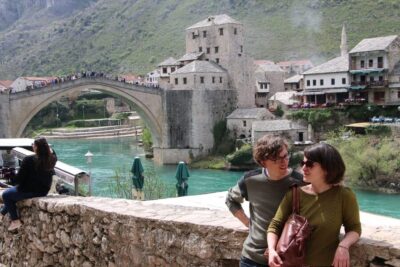
Mostar receives the largest block of time on Day 2. The guided walk covers the Ottoman bazaar, both riverbanks, the Crooked Bridge, Stari Most, and Koski Mehmet Pasha Mosque. Mostar’s famous bridge is the obvious centerpiece, but the surrounding lanes and river views give the old city its character.
The tour then checks into a hotel, leaving the rest of the day free. That free time is useful after the long drive and walking tour. You can slow down, revisit a favorite view, or simply rest. The program does not specify optional activities, so you should treat this as unplanned personal time rather than a separate guided excursion.
Blagaj, Pocitelj, and Kravice Falls show another side of Herzegovina
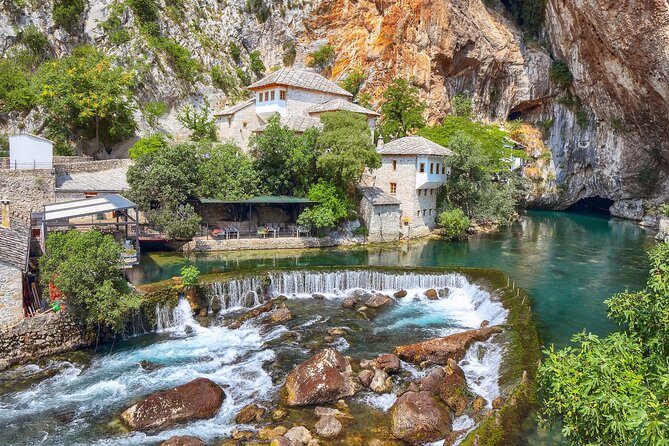
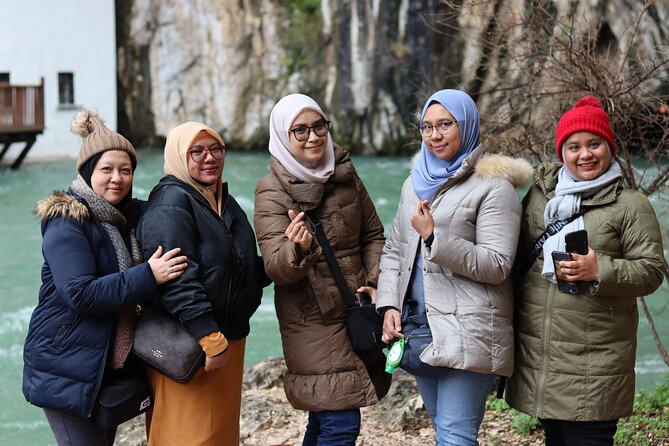
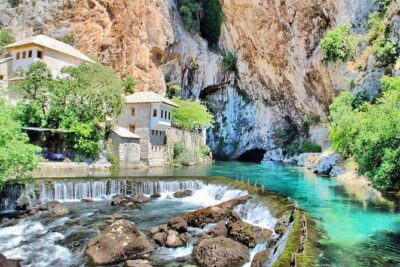
Day 3 begins with Blagaj, a village known for the source of the Buna River and the striking dervish house beside it. The stop lasts about an hour and breaks up the day nicely. The setting is quieter than Mostar, with the river spring and religious building creating a very different mood.
Next comes Pocitelj, a medieval stone town. You stop for pictures and may climb toward the sixteenth-century fortress. The wording matters: the climb is possible, but it is not presented as a guaranteed full visit. Expect uneven stone surfaces and take care on the ascent.
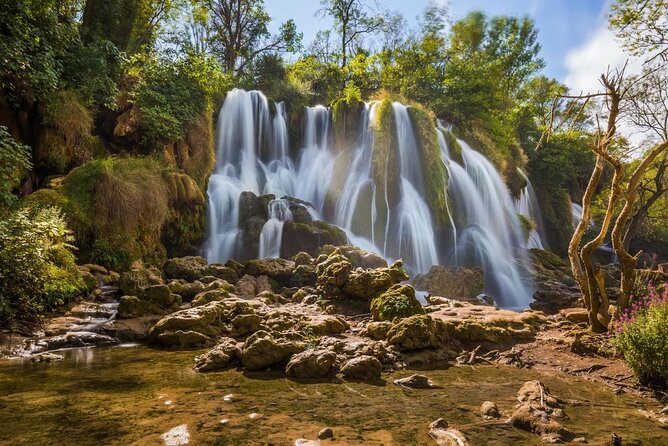
Kravice Falls receives about two hours, the longest stop of the day. Entrance is included, and the focus is on scenery and time outdoors. Afterward, the route continues to Neum, Bosnia and Herzegovina’s only coastal town, where you spend the night.
This day is better balanced than the first two. It includes history, religious heritage, a hill town, and natural scenery. Still, the program is weather-sensitive. In hot months, the open areas at Pocitelj and Kravice can feel intense, so water, sun protection, and sensible footwear will make a real difference.
A few more of this kind worth a look:
- ROSES OF SARAJEVO (Official WAR + CITY tour)- Story of a Survivor
★ 5.0 · 770 reviews - Sarajevo: Mostar, Konjic, Počitelj, Sufi House, & Waterfalls
★ 4.9 · 572 reviews - Tunnel Museum: Bosnian & Yugoslav Wars Tour with War Veteran
★ 5.0 · 551 reviews - Sarajevo: 2 Hours Old Town Walking Tour With Local Guide
★ 5.0 · 505 reviews
Dubrovnik and Montenegro pack two famous old towns together
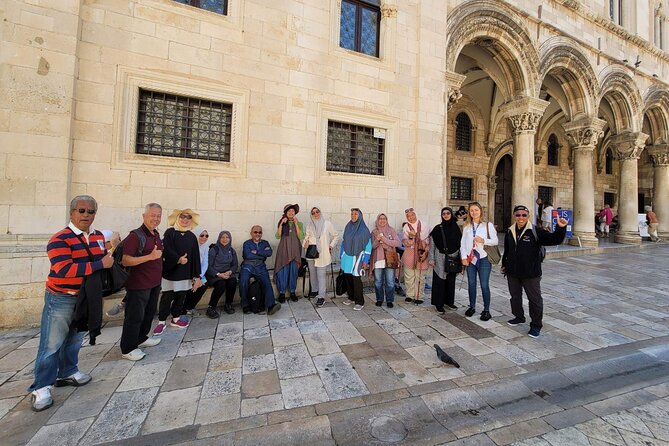
From Neum, you travel about 80 kilometers to Dubrovnik. Once inside the walled Old Town, a local guide leads the walking tour, followed by two hours of free exploration before the group continues into Montenegro.
Dubrovnik is the most famous name on the route, and three hours is enough for an introduction but not a thorough study. You can see the core of the Old Town, learn how the stone city is organized, and use the free time for photographs or a short independent walk. A full circuit of the walls is not listed, so do not assume that it is part of the program.
Kotor is the first Montenegrin stop. A local guide takes you through the Old Town for about two hours, followed by free time. Kotor’s compact center is well suited to a guided introduction, though the schedule leaves little room for longer climbs or extended exploration beyond the central streets.
A short drive brings you to Budva, where you walk through the Old Town before checking into the hotel. The remainder of the day is free. This is a practical overnight arrangement, but Day 4 remains another long day with two countries and three historic towns.
Traffic is a real consideration here. Summer roads around the Adriatic can be slow, and one detailed account of the trip described hot weather, heavy traffic, and less downtime than expected. The private vehicle helps, but it cannot make crowded roads move faster.
Shkoder and Tirana shift the mood in Albania
Day 5 crosses into Albania and begins in Shkoder. A local guide leads the town visit for about three hours before the journey continues to Tirana.
In the Albanian capital, the city-center walk includes Skanderbeg Square, Ethem Bey Mosque, Mother Teresa Square, communist bunkers, and the Pyramid. These stops give you a quick outline of Albania’s Ottoman, national, religious, and communist-era story.
The balance here is similar to the rest of the tour: guided orientation first, free evening afterward. You check into a hotel in Tirana, with the rest of the day available for your own plans. Since meals are not included, the free evening also gives you a chance to choose where and how you want to eat.
Tirana is not treated as a long urban stay. You get the essential sights and a sense of the capital, then move on. That is useful for first-time visitors who want a broad regional picture, but it may disappoint anyone hoping for museums, nightlife, or a slower look at daily life.
Ohrid provides one of the gentler stops
After checking out in Tirana, the tour travels toward Ohrid in North Macedonia. The journey takes about two hours before the border crossing and arrival in the old town, with the day listed at roughly ten hours overall.
A local guide introduces the main promenade, entrances to the Old Town, a pearl shop, the old paper factory, and St. Sofia monastery. The program then gives you the rest of the day free.
Ohrid is an important change of rhythm. The previous days emphasize road connections and several historic centers. Here, you have more room to enjoy the town at your own pace after the guided introduction. The pearl shop and paper factory also add local craft details rather than focusing only on major monuments.
The border crossing means timing can vary. You should view the stated duration as an estimate, not a guarantee. Still, the route from Tirana to Ohrid is one of the more manageable long transfers in the week.
Skopje ends with two sides of the Vardar
The final day takes about three hours from Ohrid to Skopje, with short stops along the way. In the North Macedonian capital, a local guide leads a walk on both sides of the Vardar River.
The Ottoman-influenced Old Town includes the bazaar, small shops, and restaurants. The opposite side presents the city’s Macedonian identity and Alexander the Great associations. The contrast gives you a useful way to read Skopje, even though the walking tour is brief.
After the tour, the driver transfers you to your accommodation or the airport, depending on your plans. This makes Skopje a practical endpoint, especially if you are using the tour as part of a larger trip.
The private guiding is the strongest feature
The most consistent strength is the people handling the trip. Elvis, the owner, is described as highly responsive during planning, while Edis served as a professional, polite driver and guide for one group. Zulfo was also praised for contributing to the trip beyond simply driving.
You can expect a mix of an English-speaking driver or guide and local guides in the cities. That arrangement makes sense. A driver who knows the regional roads can manage the long transfers, while local guides can explain the city they know best.
The personal accounts also point to strong storytelling and an ability to discuss both older history and current Balkan issues. That matters on a route where the past is not safely sealed behind museum glass. Sarajevo’s siege, the region’s ethnic tensions, and the different national identities in each capital all require care and context.
One account also described a French-speaking guide, suggesting language arrangements may vary. English is the officially offered language, so confirm your preferred language before booking if that is important to you.
Who should book this seven-day route?
I would recommend it to you if you want a serious first look at the Balkans and value private transport, local explanations, and hotel arrangements more than independent flexibility. It works especially well for a couple, family, or small group that wants to cover several countries without planning every border crossing and transfer.
It can also suit families with older children or teenagers. One account specifically found the storytelling engaging for a parent traveling with a teenage son. The mix of bridges, fortresses, waterfalls, markets, war history, and city walks gives younger visitors more variety than a museum-heavy trip.
I would be cautious if you dislike long drives, hot weather, or frequent hotel changes. July can bring temperatures in the 90s and sometimes above 100 degrees Fahrenheit, and road delays can reduce free time. May or September may be more comfortable, although the tour is offered throughout the stated operating period.
Pickup is available from any location in Sarajevo, and the experience is private, with only your group participating. Most people can take part, but the uneven surfaces at Pocitelj and the amount of walking in old towns are worth considering.
Should you book Tour Mage?
Book this tour if your goal is to understand the shape of the Balkans in one efficient week. You will see Sarajevo’s religious and wartime landmarks, Mostar’s bridge, Herzegovina’s rivers and falls, Dubrovnik and Kotor, Albania’s two major city stops, Ohrid, and Skopje.
Do not book it expecting a restful beach holiday or a slow cultural stay. The route is full, and the price reflects private transport, hotels, and guiding rather than low-cost independent travel.
For the right person, the value lies in the connections: one driver, several local guides, and a route that would be complicated to arrange alone. If you can handle the pace and want the broadest practical introduction to five Balkan countries, this is a strong choice.
FAQ
Where does the tour begin?
Pickup is available from any location in Sarajevo.
How long is the tour?
The experience lasts approximately seven days and includes six nights of accommodation.
Which countries does the route visit?
The route travels through Bosnia and Herzegovina, Croatia, Montenegro, Albania, and North Macedonia.
Are hotels included?
Yes. The package includes six nights in four-star hotels.
Are meals included?
Six breakfasts are included. Lunch and dinner are not included.
Is the tour private?
Yes. Only your group participates in the private tour or activity.
Just added around Sarajevo
- Srebrenica Genocide Tour from Sarajevo★ 4.5 · 3 reviews
- Mountain Village Lukomir Full Day Adventure Tour★ 5.0 · 3 reviews
- MTB Bjelasnica – Lukomir★ 5.0 · 3 reviews
- Sarajevo Under Siege: A City’s Struggle & Survival Tour★ 5.0 · 3 reviews
- Herzegovina Tour from Sarajevo: Mostar, Počitelj, Blagaj, Kravice★ 5.0 · 3 reviews
- Bosnian Kingdom Capitals: Travnik & Jajce Tour from Sarajevo★ 5.0 · 3 reviews
- Beautiful Bosnia 8 Days Tour Package★ 5.0 · 3 reviews
- Walking Tour in Sarajevo★ 5.0 · 3 reviews
Sarajevo Tours, compared.
Mostar, Konjic, Blagaj Tekke, Pocitelj & Waterfall
Read our review →
Fall of Yugoslavia, Sarajevo War Tour with Tunnel of Hope Museum and Frontlines
Read our review →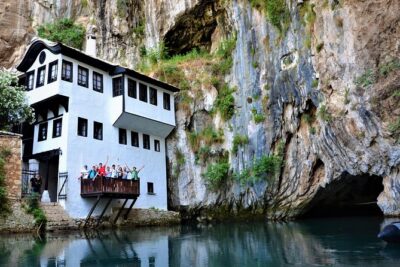
Mostar, Konjic, Sufi House, Pocitelj & Kravice Falls
Read our review →
ROSES OF SARAJEVO (Official WAR + CITY tour)- Story of a Survivor
Read our review →
Mostar, Konjic, Počitelj, Sufi House, & Waterfalls
Read our review →
Tunnel Museum: Bosnian & Yugoslav Wars Tour with War Veteran
Read our review →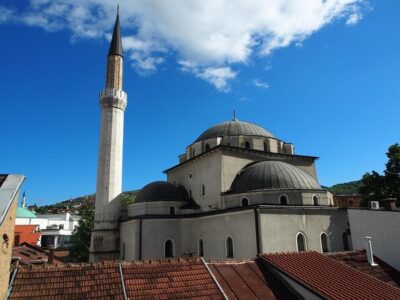
Mostar, Konjic, Dervish House, Pocitelj & Kravica Falls
Read our review →Browse the lists this tour appears in