
REVIEW · WALKING TOURS IN SARAJEVO
Sarajevo: 2 Hours Old Town Walking Tour With Local Guide
Sarajevo rewards a good first walk. This $14.51 tour packs the compact Old Town into about two hours, with a clear focus on the places where Ottoman, Austro-Hungarian, Jewish, Orthodox, Catholic, and Muslim traditions meet. I especially like the small maximum group of 10 and the smart route, which links major sights without wasting time finding them yourself.
I also like the human touch. Guides such as Ahmed, Ilma, Hanan, Benjamin, Azra, Arna, Cecilia, and Alen have been praised for clear English, local stories, patience, and honest suggestions for food and shopping. The main consideration is pace: two hours is enough for orientation and history, but not enough for long interior visits. Several admission fees are also extra.
In This Review
- Key points to know before you book
- Why this two-hour walk works so well in Sarajevo
- From the Meet Bosnia office to Sarajevo’s oldest Orthodox church
- Bascarsija, Sebilj, and the copper workers’ street
- Sarajevo City Hall and the Austro-Hungarian chapter
- Morica Han, a surviving caravanserai
- Gazi Husrev-beg Mosque and Sarajevo’s unusual clock
- The Jewish Museum and the Sarajevo Meeting of Culture
- The Sacred Heart Cathedral and religious coexistence
- Latin Bridge and the road to the First World War
- What the guides add to the walk
- Price, pace, weather, and practical value
- Who should book this Sarajevo walking tour?
- Should you book it?
- FAQ
- How long does the Sarajevo Old Town walking tour last?
- What is the price of the tour?
- Where does the tour begin?
- Where does the tour end?
- What language is the tour offered in?
- What is the maximum group size?
- Are entrance fees included?
Key points to know before you book
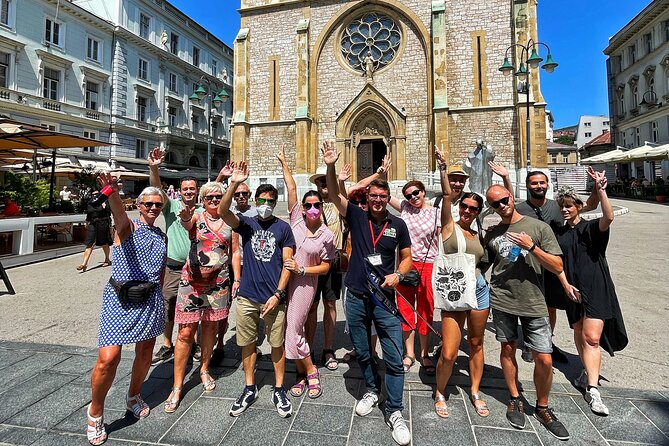
- A compact route through Sarajevo’s main meeting points: The walk connects Bascarsija, Sarajevo City Hall, the Gazi Husrev-beg Mosque, the cathedral, the Jewish Museum area, and Latin Bridge.
- The focus is cultural contact: You hear how Ottoman, Austro-Hungarian, Orthodox, Catholic, and Jewish traditions shaped one city.
- A useful first-day activity: The route gives you a map in your head, making later solo exploring easier.
- Small groups matter here: The maximum is 10 people, so you can ask questions and hear the guide in narrow streets.
- The price is modest: At $14.51 per person, this is strong value if you want an introduction rather than a long specialist tour.
- It is not mainly a 1990s war tour: Modern history may appear, but the main story runs from the Ottoman era through Austro-Hungarian rule and the assassination of Franz Ferdinand.
Why this two-hour walk works so well in Sarajevo
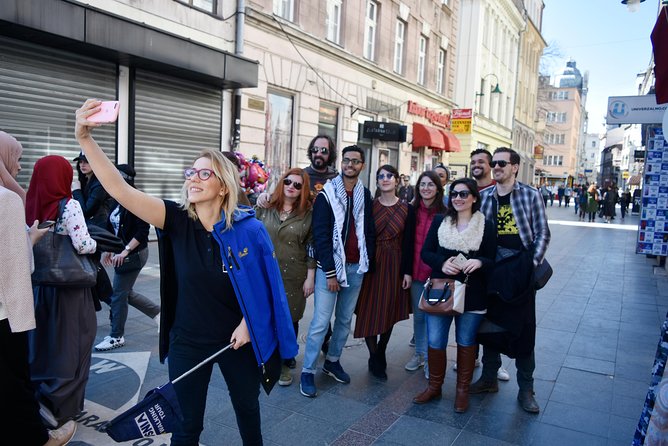
Sarajevo’s Old Town is compact, but its story is not simple. A mosque may sit close to a Catholic cathedral, a Jewish museum, an Orthodox church, and Austro-Hungarian buildings. Without context, the streets can feel like a collection of attractive façades. With a good guide, the route becomes a lesson in how different cultures lived side by side, sometimes peacefully and sometimes under great strain.
That is the strongest idea behind this tour. It does not treat Sarajevo as only an Ottoman bazaar or only a city marked by war. Instead, it follows the city’s layers. You move from the old Orthodox church to Bascarsija, from the caravanserai to the city hall, then toward the religious and political landmarks that helped shape modern Europe.
I would take this walk on my first day in Sarajevo. It gives you basic orientation, introduces the main sights, and leaves you with enough time afterward to return to the places that catch your interest.
The group size also helps. A maximum of 10 people is much easier to manage than a large crowd in the narrow streets around Bascarsija. You can ask about a detail on a building, stop for a photograph, or request a little more explanation without losing the guide.
More Walking Tours in Sarajevo
- Private Walking Tour, Food Tasting and Bosnian Coffee in Sarajevo
★ 5.0 · 255 reviews - Sarajevo Grand Walking Tour
★ 5.0 · 232 reviews - Sarajevo Essential Full Walking Tour
★ 5.0 · 198 reviews
From the Meet Bosnia office to Sarajevo’s oldest Orthodox church
The meeting point is the Meet Bosnia Travel office at Gazi Husrev begova 75, near the crossroads of Mula Mustafe Bašeskije. The tour begins with an introduction to Sarajevo and Bosnia and Herzegovina, so you get some basic background before setting off.
The first formal stop is the Church of the Holy Archangels Michael and Gabriel. The guide tells the story of what is described as Sarajevo’s oldest Orthodox church, including its legends and unusual details. The talk takes place in front of the church, and admission is not included.
This is a useful opening because it immediately broadens the story beyond the Ottoman Muslim identity most people associate with the Old Town. You begin with a reminder that Sarajevo has long been home to more than one religious community.
Do not expect a long church visit here. The listed stop is about 10 minutes, so the value comes from the explanation rather than an extended look inside.
Bascarsija, Sebilj, and the copper workers’ street
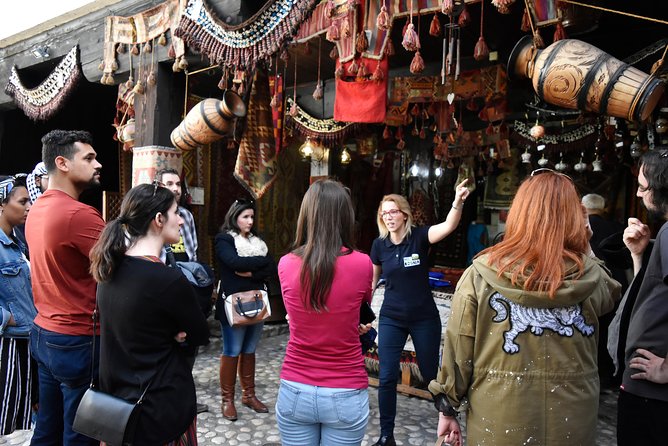
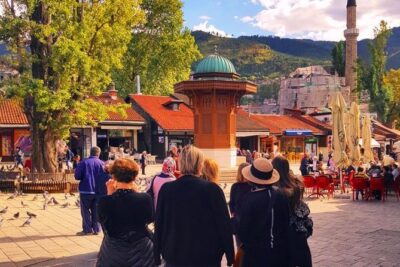
From there, the walk reaches Bascarsija, Sarajevo’s historic Ottoman quarter. The centerpiece is Sebilj, the famous wooden fountain in the square. The fountain dates from the 18th century and has become one of the city’s best-known symbols.
You will have a short dedicated stop at Sebilj, followed by time around the square and Kazandziluk. The latter is known as Sarajevo’s oldest street and is associated with handmade copperwork. Look for the traditional objects displayed by the craftspeople, but keep your expectations practical: this is a brief introduction, not a shopping session.
I like this part of the route because the history is visible at street level. You are not only hearing about the Ottoman period in a lecture. You are walking through the market quarter, seeing the fountain, and passing workshops connected with an old craft tradition.
The square can be active, and the streets are not wide. A small group makes it easier to stay close to the guide. It also helps if you want to hear the explanation rather than simply follow a flag through the crowd.
Sarajevo City Hall and the Austro-Hungarian chapter
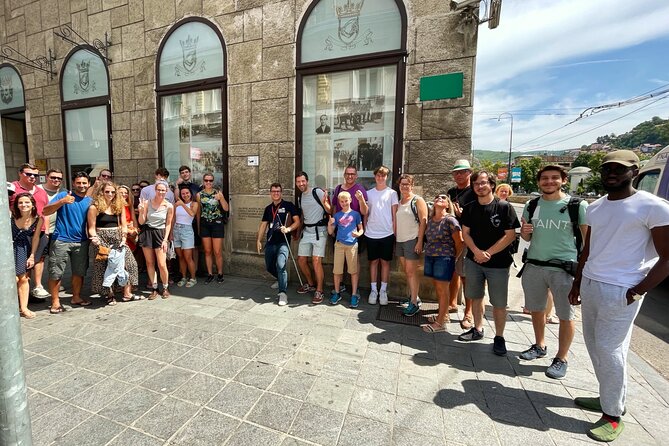
The route then shifts in tone at Sarajevo City Hall, one of the city’s grandest Austro-Hungarian buildings. The guide explains its construction and its former role as a national library. Admission is not included, so the tour concentrates on the exterior and the building’s place in Sarajevo’s story.
This change from Ottoman streets to Austro-Hungarian architecture is one of the walk’s best teaching moments. In a short distance, the visual language changes sharply. The contrast helps you understand why Sarajevo is often described as a meeting point between East and West.
The guide’s explanation matters here. A building this ornate can be admired quickly, but its former use and later story give it more weight. You learn that it was not simply a decorative civic building, but part of the city’s intellectual and public life.
The route gives you about 15 minutes at the city hall. That is enough for an exterior explanation and photographs, but not for a full architectural visit.
More walking tours:
- Delicious Sarajevo: Eat, Walk & Discover City Tour
★ 4.5 · 37 reviews - PROFESSIONAL SARAJEVO WALKING TOUR – With guide who guided STING!
★ 5.0 · 29 reviews - Sensational Sarajevo Sunset Walking Tour
★ 4.5 · 26 reviews - Sarajevo genuine walking tour: Steps through history
★ 5.0 · 22 reviews
Morica Han, a surviving caravanserai
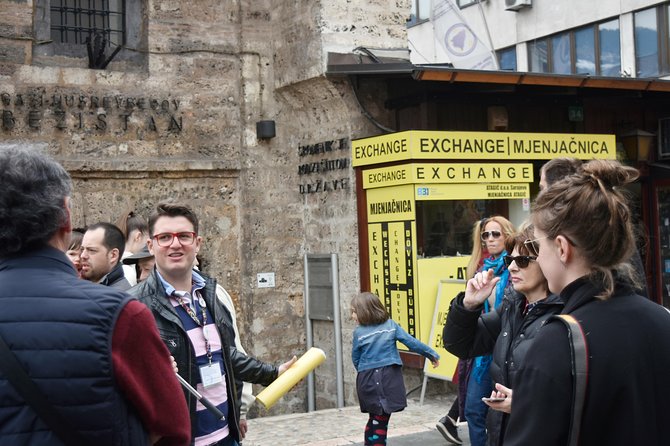
Morica Han offers a different view of old Sarajevo. This former caravanserai provided lodging for merchants and other people passing through the city. The tour presents it as one of the most authentic surviving examples in the Balkans.
The stop lasts around 10 minutes and admission is free. Its importance is easy to miss if you do not know what you are looking at. A caravanserai was tied to trade, movement, and hospitality, so this courtyard helps explain how Sarajevo functioned as a crossroads.
I would pay attention to the practical side of the story here. The Old Town was not only a place of worship and government. It was also a working commercial center where people arrived, traded, rested, and moved on.
Gazi Husrev-beg Mosque and Sarajevo’s unusual clock

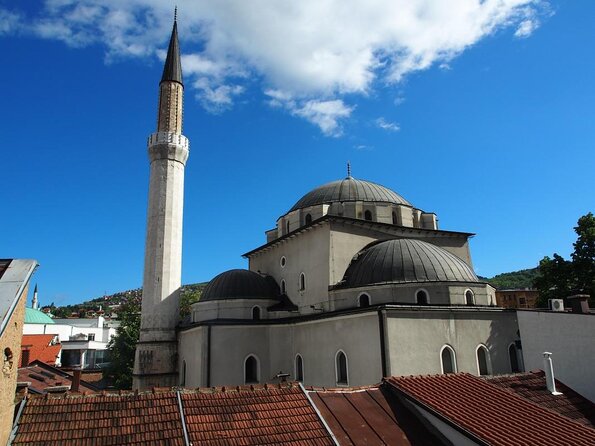
The Gazi Husrev-beg Mosque is one of the central landmarks of Sarajevo. The guide discusses its ornamentation and place in the city, then points out the nearby clock tower.
The mosque is one of the stops where admission is not included. The schedule allows about 20 minutes, which gives you time to hear the explanation and take in the setting. If you hope to enter religious buildings, check the conditions on the day and dress respectfully. The supplied tour details do not promise an interior visit.
The Old Sarajevo Clock Tower has its own intriguing detail: it shows authentic lunar time, a system connected with Muslim prayer times. That makes it unusual in a way you might not notice from the outside. The dedicated clock stop is only about five minutes, but the guide’s explanation gives the landmark a clear purpose.
This is a good example of the tour’s approach. You are not simply collecting monuments. You are learning why a fountain, mosque, clock tower, and market street mattered to the people who used them.
The Jewish Museum and the Sarajevo Meeting of Culture
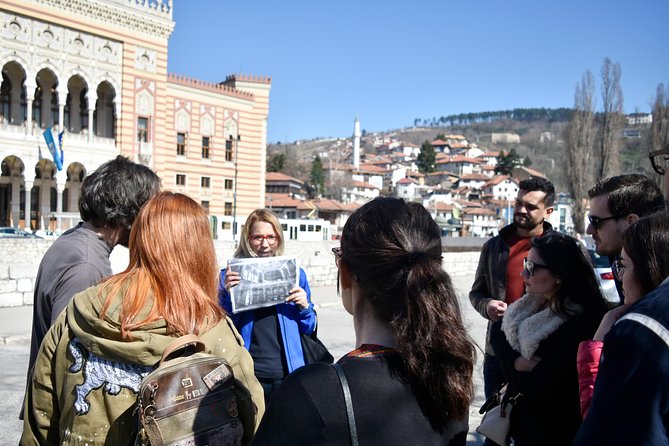
The Jewish Museum of Bosnia and Herzegovina occupies a former Sephardic synagogue. The guide explains the long presence of Jews in Bosnia and Herzegovina, and entry is optional and not included.
That optional arrangement suits a two-hour walk. You can stay with the group for the explanation, then decide later if you want to return for a fuller museum visit. If Jewish Sarajevo is a major interest, plan extra time on your own, since the walking tour cannot provide a detailed museum visit within its schedule.
Nearby, the Sarajevo Meeting of Culture marks the point where the city’s Ottoman and Austro-Hungarian sides meet. It is a simple but effective place to pause. One direction leads toward the eastern, Ottoman-style quarter, while the other points toward the western, Austro-Hungarian part of the city.
This is probably the clearest physical expression of the tour’s central theme. You can see the shift in architecture and atmosphere within a few steps. The guide helps connect that visual contrast with Sarajevo’s social and political history.
The Sacred Heart Cathedral and religious coexistence
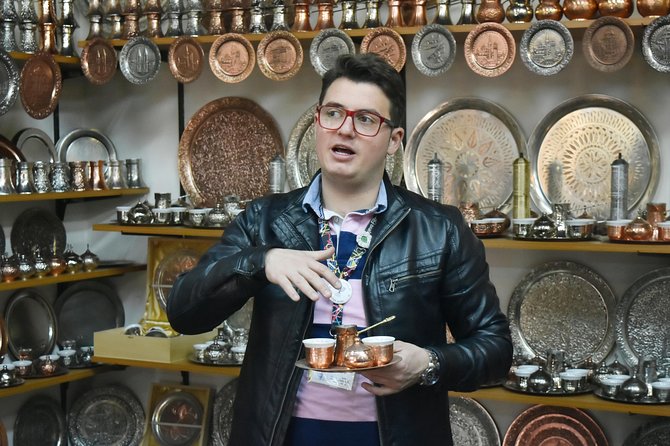
The Cathedral of the Sacred Heart of Jesus is presented as one of Sarajevo’s most beautiful Catholic churches. The stop includes a story about Catholics in Bosnia and Herzegovina, and admission is listed as free.
Placed after the Jewish Museum and the Meeting of Culture, the cathedral helps complete the picture of Sarajevo’s religious variety. The route has already introduced an Orthodox church, Muslim landmarks, and Jewish heritage. Now you see the Catholic chapter in the city’s story.
The planned stop is about 15 minutes. That is enough for a short visit and explanation, but you should not expect a guided art-history tour of the cathedral. The strength is the sequence: each religious site gains meaning from the ones you saw before it.
Several guides have been praised for making these subjects easy to follow in English. Hanan, for example, was noted for answering questions openly and adding personal stories. Arna was also praised for linking historical events with local food, daily life, and practical ideas for the rest of a visit.
Latin Bridge and the road to the First World War
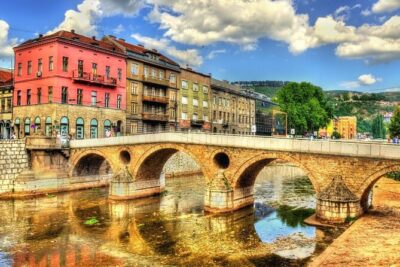
The final major stop is Latin Bridge, where the guide explains the assassination of Archduke Franz Ferdinand. The event helped trigger the First World War, and the location remains one of Sarajevo’s most important historical sites.
The scheduled talk lasts about 20 minutes. That is a generous portion of a two-hour walk, and rightly so. The significance is not only the event itself, but the chain of political tensions and consequences that followed.
A good guide will place the assassination in context rather than present it as an isolated dramatic moment. Guides such as Alen and Viki have been praised for explaining events before 1914 and connecting the city’s longer story with modern life.
This is also where you should keep the tour’s scope in mind. The route may touch on more recent history, but it is not designed as a dedicated Siege of Sarajevo or 1990s war-sites tour. If that is your main interest, you will need a separate experience.
What the guides add to the walk
The guide is the main reason to choose this paid walk instead of simply wandering through the Old Town. The route itself is easy to follow, but the meaning of the places is not always obvious.
The guide roster varies. Past guides have included Ahmed, Ilma, Hanan, Benjamin, Azra, Sara, Mesud, Arna, Alen, Cecilia, Muhammad, Amina, Viki, Kiki, and others. The strongest pattern is clear English, a warm manner, and a willingness to answer questions.
Some guides have academic backgrounds in history or art. Others bring personal experience of Sarajevo’s recent past. One guide was described as having lived through the 1990s conflict as a child, which added a personal dimension to the discussion. That kind of perspective can be powerful, but the exact guide and style will depend on the day.
The small group format gives you the best chance to benefit from that personal approach. You can ask about local habits, food, shopping, religion, or the history of a particular street instead of receiving only a fixed speech.
Price, pace, weather, and practical value
At $14.51 per person, the tour is inexpensive for a guided introduction. You are paying for about two hours with a local professional guide, a planned route, and the chance to ask questions. For a first morning or afternoon in Sarajevo, I consider that good value.
The low price does not cover food, drinks, or admission fees. The Jewish Museum, Gazi Husrev-beg Mosque, Sarajevo City Hall, and the Orthodox church are listed with admission not included, though some stops are simply exterior talks or optional entries. Bring a little extra if you want to go inside places that charge admission.
The tour is offered in English, but the guide may be multilingual. Confirmation is provided at booking, and the service is near public transportation. Service animals are allowed, and most people can take part.
Wear comfortable shoes. The route is on foot, and the Old Town streets can be uneven or crowded. Rain is not necessarily a deal breaker. Guides have managed the walk in light rain and even heavy downpours, while adjusting for comfort. In hot weather, shade becomes useful, and one guide was praised for finding shaded places along the way.
The activity ends back at the Meet Bosnia office. That is handy because you can collect your bearings and then continue exploring from a familiar point.
Who should book this Sarajevo walking tour?
I would choose this tour if you have limited time, want a clear introduction, or prefer history explained by a local rather than read from a guidebook. It suits first-time visitors, families, solo visitors, and anyone who wants to understand why Sarajevo looks and feels so different from one block to the next.
It is also a good match if you care about the Ottoman and Austro-Hungarian periods, religious coexistence, Jewish heritage, and the First World War. Families can benefit from the shorter format and small group, especially when children have questions.
I would look elsewhere if you want a long museum tour, a food-focused experience, or a detailed examination of the 1990s siege. Those subjects may appear briefly, but they are not the main purpose here.
Should you book it?
Yes, if you want an affordable, well-organized first look at Sarajevo. The route covers an impressive number of landmarks, and the focus on cultural meeting points gives the walk more purpose than a simple checklist of sights.
Book it early if your schedule is tight, since the tour is commonly reserved well ahead of time. If you cancel at least 24 hours before the start, you can receive a full refund. The company may cancel if the minimum number is not reached, in which case you are offered another date or experience, or a full refund.
For $14.51, the tour earns its place as a first-day activity. It will not tell you everything about Sarajevo, but it gives you the right questions to ask and the right streets to explore next.
FAQ
How long does the Sarajevo Old Town walking tour last?
The tour lasts approximately two hours.
What is the price of the tour?
The listed price is $14.51 per person.
Where does the tour begin?
It begins at the Meet Bosnia Tours office at Gazi Husrev begova 75, near the crossroads of Mula Mustafe Bašeskije in Sarajevo.
Where does the tour end?
The activity ends back at the meeting point.
What language is the tour offered in?
The tour is offered in English. It may be operated by a multilingual guide.
What is the maximum group size?
The maximum group size is 10 people.
Are entrance fees included?
No. Food and drinks are not included, and admission fees for some locations are extra. Entry to the Jewish Museum is optional.
Just added around Sarajevo
- Srebrenica Genocide Tour from Sarajevo★ 4.5 · 3 reviews
- Mountain Village Lukomir Full Day Adventure Tour★ 5.0 · 3 reviews
- MTB Bjelasnica – Lukomir★ 5.0 · 3 reviews
- Sarajevo Under Siege: A City’s Struggle & Survival Tour★ 5.0 · 3 reviews
- Herzegovina Tour from Sarajevo: Mostar, Počitelj, Blagaj, Kravice★ 5.0 · 3 reviews
- Beautiful Bosnia 8 Days Tour Package★ 5.0 · 3 reviews
- Bosnian Kingdom Capitals: Travnik & Jajce Tour from Sarajevo★ 5.0 · 3 reviews
- Walking Tour in Sarajevo★ 5.0 · 3 reviews
Walking Tours in Sarajevo, compared.
Private Walking Tour, Food Tasting and Bosnian Coffee in Sarajevo
Read our review →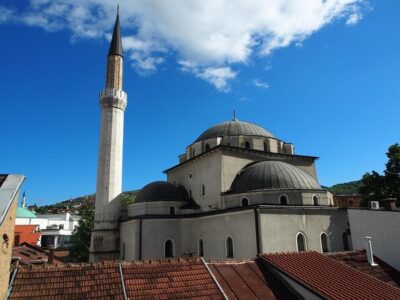
Delicious Sarajevo: Eat, Walk & Discover City Tour
Read our review →
PROFESSIONAL SARAJEVO WALKING TOUR – With guide who guided STING!
Read our review →
Sarajevo genuine walking tour: Steps through history
Read our review →
Browse the lists this tour appears in