
REVIEW · WALKING TOURS IN SARAJEVO
Walking Tour in Sarajevo
Sarajevo reveals itself one street at a time. This private walk connects the city’s Ottoman bazaars, Austro-Hungarian buildings, Jewish heritage, and Christian landmarks in a compact route through the center. I like the clear East-meets-West theme, and I like that guide Suvad brings personal stories and detailed answers to difficult questions. The main drawback is that the tour may last anywhere from one to three hours, so the depth of the experience can depend on the pace and time available at each stop.
The price is $69.46 for a private group of up to four people, which is fair if you are sharing it with family or friends. You will hear about Sarajevo’s food, faiths, architecture, and wartime past without being folded into a large group. Still, confirm the transport details before booking, since pickup is offered but private transportation is listed as not included.
In This Review
- Key things to know before you book
- Why this Sarajevo walk works so well
- Starting at City Hall and the Miljacka River
- Čevapi, pita, and the taste of Sarajevo
- Kazandžiluk and the craft streets of Baščaršija
- Sebilj Fountain and Morića Han
- Gazi Husrev-beg Mosque and the Ottoman city plan
- The 1914 assassination and the road to World War I
- Bezistan and the shift from Istanbul to Vienna
- Jewish Sarajevo and the former Sephardic synagogue
- The Cathedral of the Sacred Heart
- Serbian Orthodox Cathedral and the Multicultural Man
- What the $69.46 price really buys you
- Who should book this tour?
- Should you book the Sarajevo walking tour?
- FAQ
- Where does the tour start?
- What time does the tour begin?
- Where does the tour end?
- How long does the tour last?
- How many people can join the private tour?
- How much does the tour cost?
- Is food included?
- Are admission tickets included?
- Is pickup available?
- Can I cancel for a full refund?
Key things to know before you book
- Sarajevo’s East-West meeting point: The walk shows how Ottoman Sarajevo and Austro-Hungarian Sarajevo sit side by side, with a clear transition from small Istanbul to small Vienna.
- A private group for up to four: You can ask questions freely and adjust the conversation around your interests.
- A strong food and coffee angle: The route passes places known for čevapi and pita, along with shops connected to Turkish coffee and traditional copperware.
- Major religious landmarks: The tour includes the Gazi Husrev-beg Mosque, Cathedral of the Sacred Heart, Serbian Orthodox Cathedral, and the former Sephardic synagogue.
- The Sarajevo assassination site: You will discuss Gavrilo Princip and the event that helped trigger World War I.
- Simple cancellation terms: You can receive a full refund if you cancel at least 24 hours before the 9:00 am start.
Why this Sarajevo walk works so well
Sarajevo is easiest to understand on foot. Its central streets bring together mosques, churches, a covered bazaar, Ottoman inns, coffee shops, food counters, and Austro-Hungarian facades within a short distance. A good guide helps you notice not only the monuments, but also the changes in sound, smell, building style, and street life.
That is the strength of this experience. It does not focus on one period alone. You move from Ottoman Sarajevo to the Habsburg era, then into the city’s Jewish and Christian story, with the assassination of Archduke Franz Ferdinand linking the historical sections.
The guide named in the booking information is Suvad. The comments about his work highlight two useful qualities: strong communication before the tour and a willingness to answer awkward or complicated questions. That matters in Sarajevo, where a simple building or street corner can raise questions about empire, religion, nationalism, war, and memory.
You should also expect a flexible feel because this is a private activity. The group size is limited to your party, up to four people. That makes it easier to pause at the food stops, ask for more detail at the mosque, or spend less time on a subject that does not interest you.
More Walking Tours in Sarajevo
- Sarajevo: 2 Hours Old Town Walking Tour With Local Guide
★ 5.0 · 505 reviews - Private Walking Tour, Food Tasting and Bosnian Coffee in Sarajevo
★ 5.0 · 255 reviews - Sarajevo Grand Walking Tour
★ 5.0 · 232 reviews
Starting at City Hall and the Miljacka River
The tour begins at Telali 19 at 9:00 am and heads toward Sarajevo City Hall. The building is one of the city’s best introductions because its appearance reflects the Austro-Hungarian period rather than the Ottoman quarter you will visit later.
You will hear about its construction, changing uses, destruction, and reconstruction. The building also helps set up one of the tour’s main ideas: Sarajevo has been shaped by several political and cultural eras, and those layers remain visible within a few blocks.
The visit is described as a stop outside or around the building, with admission not included. If you want to go inside, ask the guide whether there is enough time and check the entrance cost separately. The scheduled discussion is only about five minutes, so this part is more of an orientation than a full interior visit.
Čevapi, pita, and the taste of Sarajevo
The route then moves through a street known for čevapi and pita. These are two of the most useful foods to understand early in a Sarajevo visit.
Čevapi are small grilled meat portions served in a local style, while pita refers to filled pastry dishes. The tour gives you a chance to see how the food is made, not simply hear a list of dishes from a guide. The smell of grilled meat and baked pastry is part of the experience, and it gives the walk a welcome everyday quality.
Food is not listed as included, so plan to pay separately if you want to eat. The tour description does not promise a tasting, but the route gives you the chance to stop for food. I would ask Suvad at the beginning if you want enough time for a proper snack or meal.
Kazandžiluk and the craft streets of Baščaršija
Kazandžiluk is one of Sarajevo’s most atmospheric streets. The name is linked to the traditional craft of making copperware, and the walk introduces you to shopkeepers and the objects associated with Ottoman-era Sarajevo.
You will hear about coffee preparation and tasting, pot making, decoration, and daily life during the Ottoman period. This is a useful stop because it connects architecture with ordinary work. Instead of seeing the bazaar only as a picturesque shopping street, you get a sense of the trades that helped the quarter function.
The scheduled stop is brief, listed at about five minutes, but the private format may allow a little more conversation. Do not expect a formal craft demonstration unless the shopkeepers happen to be working and the timing allows it. The real value is the guide’s explanation of what you are seeing.
More walking tours:
- Sarajevo Essential Full Walking Tour
★ 5.0 · 198 reviews - Delicious Sarajevo: Eat, Walk & Discover City Tour
★ 4.5 · 37 reviews - PROFESSIONAL SARAJEVO WALKING TOUR – With guide who guided STING!
★ 5.0 · 29 reviews - Sensational Sarajevo Sunset Walking Tour
★ 4.5 · 26 reviews
Sebilj Fountain and Morića Han
The wooden Sebilj Fountain is one of the best-known meeting points in Sarajevo. Here, the guide explains its creation, history, and changing use over the centuries. It is a natural place to pause because the fountain sits in the middle of the old bazaar area, surrounded by the sounds and smells that define this part of the city.
The next major stop is Morića Han, an Ottoman caravanserai. Caravanserais provided lodging and storage for merchants and their animals moving along long-distance trade routes. You will hear about caravans traveling through the region and see how this inn fits into Sarajevo’s commercial past.
Morića Han also includes a carpet shop with traditional Bosnian carpets. The stop is listed at about ten minutes, and admission is free. You may browse, but the tour does not include a purchase or a carpet demonstration. If shopping interests you, a private tour gives you a better chance to ask about patterns and local traditions without holding up a larger group.
Gazi Husrev-beg Mosque and the Ottoman city plan
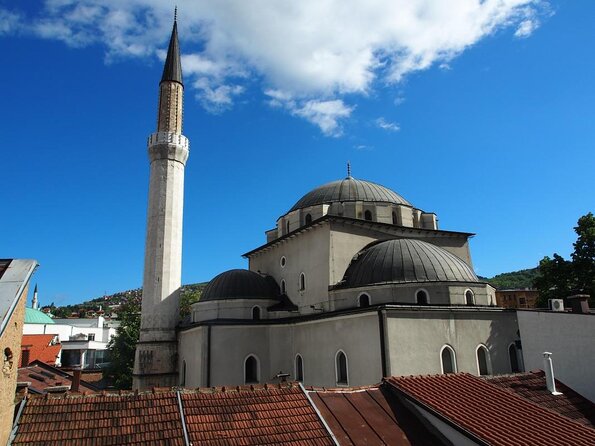
The Gazi Husrev-beg Mosque is one of the most important stops on the route. The guide discusses its construction and use, then expands the story to include the Islamic school, public toilets, library, and surrounding neighborhood built with it during the 16th century.
That broader explanation is valuable. A mosque in Sarajevo was not an isolated building. It formed part of a larger civic and religious complex, with spaces for education, reading, washing, public needs, and community life.
The scheduled visit lasts about 15 minutes. Admission is not included, and the tour specifically describes time in the courtyard. Dress and entry rules can vary, so ask what is appropriate if you hope to enter the prayer area. If access is not possible, the courtyard and the guide’s explanation still provide a useful view of the complex.
This stop also gives you a chance to hear the call from the minarets, one of the sounds the tour promises along with church bells. Sarajevo’s religious buildings are close enough together that the city’s soundscape becomes part of the lesson.
The 1914 assassination and the road to World War I
At the Sarajevo Museum, you stop near the place connected with the assassination of Austro-Hungarian Archduke Franz Ferdinand in 1914. The guide discusses Gavrilo Princip, shows photographs of the assassin, and explains the causes and consequences of the event.
The stop is listed at about ten minutes, with museum admission not included. The emphasis is on the location and the historical explanation rather than a guaranteed museum visit.
This is one of the places where a guide adds real value. The assassination itself is easy to remember as a dramatic event, but the political tensions behind it are harder to grasp. Suvad’s ability to answer difficult questions is especially useful here, since the subject involves the Austro-Hungarian Empire, Serbian nationalism, Bosnia, and the chain of events that led to World War I.
You should not expect the whole story of the 20th century to fit into ten minutes. Instead, treat this as a clear starting point. If the subject interests you, return later for a longer museum visit or further reading.
Bezistan and the shift from Istanbul to Vienna
Gazi-Husrev Beg’s Bezistan is a covered bazaar dating from the 16th century. The building was created as a copy of Istanbul’s Kapalı Çarşı, or Grand Bazaar, and walking through it makes the Ottoman connection especially clear.
This is a short stop, listed at about five minutes, and admission is free. The covered passage is less about a formal talk and more about seeing how trade was organized in the old city.
Soon after, you reach the Sarajevo Meeting of Culture marker. This spot represents the transition between Ottoman Sarajevo and the Austro-Hungarian city. The change can be read in the buildings and street design: one side points toward the Ottoman bazaar, while the other leads into the more European-looking center.
The phrase small Istanbul meets small Vienna is not just a slogan here. The route gives you a physical way to understand it. You are not being asked to compare two distant cities in the abstract. You can see the shift within a short walk.
Jewish Sarajevo and the former Sephardic synagogue
The Jewish Museum of Bosnia and Herzegovina is the next important historical stop. The guide discusses the Sephardic Jewish community, the Haggadah, the Holocaust, and people recognized as Righteous among Nations.
The museum is housed in what was once a Sephardic synagogue, and the stop is described as a discussion outside the building. Admission is not included. If you want to visit the interior, ask about opening arrangements and allow additional time.
The Haggadah is a particularly meaningful subject. This illuminated manuscript is tied to Sarajevo’s Jewish heritage and shows how books, faith, and community life survived through periods of upheaval. The Holocaust discussion adds a serious layer to the walk, while the mention of Righteous among Nations points toward the people who helped others during that dark period.
This is not a stop to rush. The scheduled time is about ten minutes, but the private format lets you ask for more context. If the group includes children, the guide can likely adjust the level of detail, but the supplied information does not promise a special family program.
The Cathedral of the Sacred Heart
The Cathedral of the Sacred Heart brings you into the Austro-Hungarian chapter of Sarajevo’s story. You will hear about its Neo-Gothic design and about papal visits in 1997 and 2015.
The cathedral is free to enter according to the tour details, and the stop lasts about ten minutes. It provides a useful contrast with the Ottoman mosque and covered bazaar you have already seen.
The building also helps show that Sarajevo’s identity cannot be reduced to one faith or one empire. The route has already introduced Islam and Judaism, and the cathedral adds the Catholic community to the picture. The guide’s job here is not simply to point out architectural details, but to connect the building to Sarajevo’s wider religious life.
Serbian Orthodox Cathedral and the Multicultural Man
The tour finishes near the Serbian Orthodox Cathedral, where you discuss its ornate architecture and the Serbian community in Sarajevo. The stop is listed at about ten minutes, although the itinerary also includes a square with large chess pieces and the Multicultural Man monument.
The end point is in front of the Cathedral Church of the Nativity of the Theotokos, at the square beside the monument. This is a thoughtful place to finish because the route has moved through several communities and periods without treating any one of them as the whole story.
The oversized chess set adds a lighter note after the more serious subjects of war, persecution, and political conflict. The Multicultural Man monument brings the focus back to Sarajevo as a city shaped by several communities living close together.
Because the tour ends here rather than returning to the starting point, you can continue exploring on your own. The walk is also near public transportation, according to the practical details provided.
What the $69.46 price really buys you
At $69.46 per group of up to four people, the cost works out well for a small private party. Four people would pay about $17.37 each. Two people would pay about $34.73 each, which is still reasonable if you value personal attention and the ability to ask questions.
You are paying mainly for the guide’s time and interpretation. Food, museum admission, mosque admission, and private transportation are not included. The experience lists an air-conditioned vehicle and WiFi on board, but it is described as a walking tour and also says private transportation is not included. That combination is unclear, so I would confirm whether the vehicle applies only to pickup or to a specific part of the service.
The walk is listed as lasting one to three hours. That is a wide range. A one-hour version would be a fast overview, while a three-hour version would allow more questions, food stops, and time at the religious and cultural sites. Ask before starting how much time has been planned.
Who should book this tour?
I would choose this experience if you want a first look at Sarajevo that combines architecture, food, religion, and major historical events. It is especially useful for first-time visitors who want to understand why the city feels different from one block to the next.
It also suits couples, families, and small groups of friends. The private format gives you a better chance to shape the conversation, and the route is short enough to fit into a morning.
You may want another option if you prefer long museum visits, a detailed war-focused tour, or a fully scheduled food tasting. Several stops are short, and several admissions are extra. The walk gives you a strong framework, but you may need to return to selected sites for a deeper look.
Book at least a day ahead if possible. The experience is often reserved around nine days in advance, and the start time is fixed at 9:00 am. Confirmation arrives when you book, service animals are allowed, and most people can take part. It requires good weather and a minimum number of participants, with a different date or full refund offered if the operator cancels.
Should you book the Sarajevo walking tour?
Book it if you want a private, guide-led introduction to Sarajevo’s central quarters and can make good use of Suvad’s personal stories and clear explanations. The strongest feature is the route itself: Ottoman workshops, a caravanserai, a mosque complex, World War I history, a Sephardic synagogue, Catholic architecture, and Serbian Orthodox heritage all appear in one compact walk.
Before paying, confirm three points: the expected tour length, which sites you will enter, and how pickup relates to the listed vehicle. If those details suit your plans, $69.46 for up to four people is a sensible price for a personal introduction to Sarajevo.
FAQ
Where does the tour start?
The tour starts at Telali 19 in Sarajevo, Bosnia and Herzegovina.
What time does the tour begin?
The start time is 9:00 am.
Where does the tour end?
It ends in front of the Cathedral Church of the Nativity of the Theotokos, at the square beside the Multicultural Man monument.
How long does the tour last?
The approximate duration is one to three hours.
How many people can join the private tour?
The price covers a private group of up to four people.
How much does the tour cost?
The listed price is $69.46 per group of up to four people.
Is food included?
Food is not listed as included. The route passes places known for čevapi and pita, and you may have an opportunity to see how they are prepared.
Are admission tickets included?
Admission is not included for Sarajevo City Hall, Gazi Husrev-beg Mosque, Muzej Sarajeva, and the Jewish Museum of Bosnia and Herzegovina. The listed stops at Kazandžiluk, Morića Han, Gazi-Husrev Beg’s Bezistan, the Cathedral of the Sacred Heart, and the Serbian Orthodox Cathedral are described as free or outside visits.
Is pickup available?
Pickup is offered, but private transportation is listed as not included. The tour also lists an air-conditioned vehicle and WiFi on board, so confirm the exact pickup and vehicle arrangements before booking.
Can I cancel for a full refund?
Yes. You can cancel at least 24 hours before the local start time for a full refund. Cancellations or changes made less than 24 hours before the start are not accepted for a refund.
Just added around Sarajevo
- Srebrenica Genocide Tour from Sarajevo★ 4.5 · 3 reviews
- Mountain Village Lukomir Full Day Adventure Tour★ 5.0 · 3 reviews
- MTB Bjelasnica – Lukomir★ 5.0 · 3 reviews
- Sarajevo Under Siege: A City’s Struggle & Survival Tour★ 5.0 · 3 reviews
- Herzegovina Tour from Sarajevo: Mostar, Počitelj, Blagaj, Kravice★ 5.0 · 3 reviews
- Bosnian Kingdom Capitals: Travnik & Jajce Tour from Sarajevo★ 5.0 · 3 reviews
- Beautiful Bosnia 8 Days Tour Package★ 5.0 · 3 reviews
- Travnik, Jajce, Pliva Lakes & Mills –Medieval & Ottoman Bosnia Full Day Tour★ 5.0 · 3 reviews
Walking Tours in Sarajevo, compared.
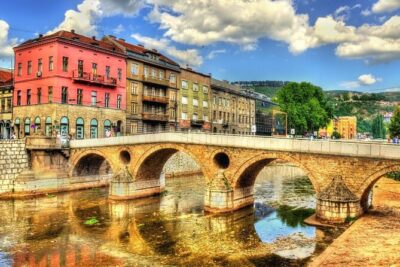
Private Walking Tour, Food Tasting and Bosnian Coffee in Sarajevo
Read our review →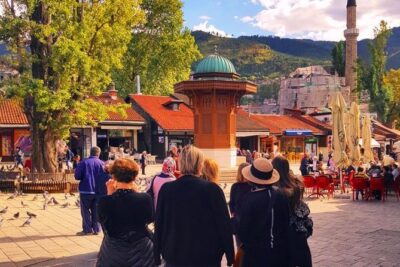
Delicious Sarajevo: Eat, Walk & Discover City Tour
Read our review →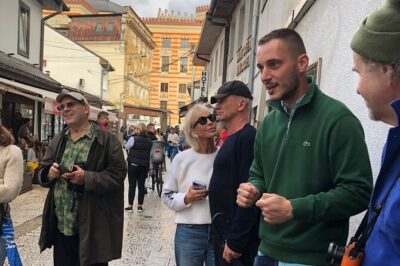
PROFESSIONAL SARAJEVO WALKING TOUR – With guide who guided STING!
Read our review →
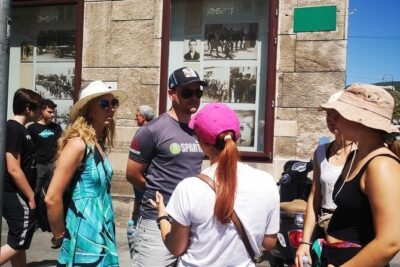
Sarajevo genuine walking tour: Steps through history
Read our review →Browse the lists this tour appears in