
REVIEW · WALKING TOURS IN SARAJEVO
Private Walking Tour, Food Tasting and Bosnian Coffee in Sarajevo
Sarajevo tells its story over coffee. This private walking tour pairs old-town history with generous tastings, so you get far more than a quick look at monuments. I like the personal format, and I like that the route links Ottoman, Austro-Hungarian, and modern Bosnian life in one compact walk. The main consideration is the pace: two and a half hours covers a lot, but several stops are brief.
The $66.54 price feels fair if you value a private guide, food, coffee, and local orientation in one outing. Guides such as Emina and Lamija have been praised for clear explanations, warm conversation, and useful suggestions for the rest of a Bosnia trip. Food portions can be large, so arrive hungry rather than treating this as a small snack walk.
In This Review
- Key things to know before booking
- Starting beside Sarajevo City Hall
- Copperwork and the meaning of Bosnian coffee
- Morica Han and a proper coffee pause
- Bravadžiluk Street turns history into lunch
- A clock tower with an unusual time
- Three faiths close together
- Gazi Husrev Bey’s Bezistan and the old bazaar
- Latin Bridge and the event that changed Europe
- What the private format adds
- Price, timing, and who gets the best value
- Should you book this Sarajevo food and coffee tour?
- FAQ
- Where does the tour start?
- Where does the tour finish?
- How long does the tour last?
- How much does the tour cost?
- Is this a private tour?
- What language is offered?
- Is food included?
- Is Bosnian coffee included?
- Can I cancel for a refund?
Key things to know before booking
- You begin at Sarajevo City Hall: The meeting point is Brodac 1, beside one of the city’s most striking buildings.
- The route crosses Sarajevo’s major cultural layers: Ottoman bazaars, Austro-Hungarian monuments, religious buildings, and sites tied to World War I all appear.
- Bosnian coffee is part of the experience: You learn how it is prepared and served, then drink it in the traditional way at Morica Han.
- Food is more than a token sample: Bravadziluk Street is used to explain and recommend traditional dishes and sweets, with a substantial meal-style tasting.
- It is private: Only your group takes part, which makes it easier to ask questions and shape the conversation.
- The walk ends near Latin Bridge: You finish close to the assassination site connected with the beginning of World War I.
Starting beside Sarajevo City Hall
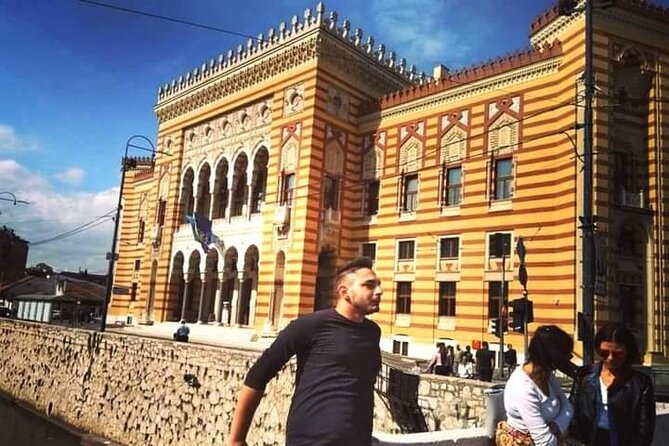
The tour begins at Sarajevo City Hall, known locally as Vijećnica, on Brodac Street. This grand Austro-Hungarian building is a useful starting point because it immediately shows you one of Sarajevo’s many cultural turns.
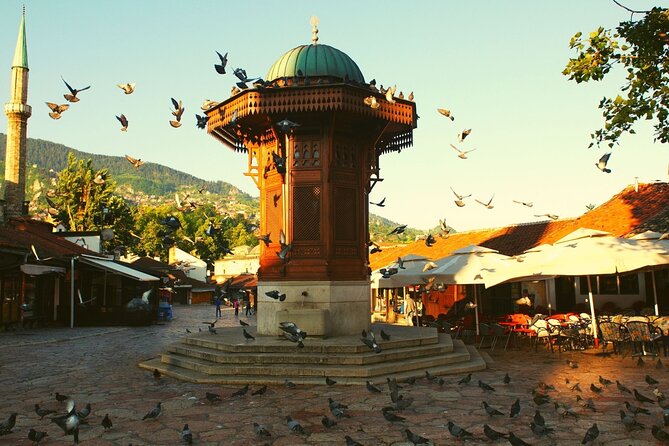
Your guide introduces the story of Bosnia and Sarajevo before leading you toward Baščaršija. The opening stop is Sebilj, the wooden fountain in Baščaršija’s main square, often called Pigeon Square. You have about 25 minutes here, the longest single stop at the start of the walk.
Sebilj is attractive in its own right, but the real value is the explanation around it. Sarajevo’s old center is not just a pretty collection of shops and paving stones. It reflects Ottoman planning, trade, religious life, and the city’s position between larger empires.
I would pay close attention here. A good introduction helps the rest of the walk make sense, especially when the route shifts from Ottoman streets to Austro-Hungarian buildings and then to places marked by the twentieth century.
More Walking Tours in Sarajevo
- Sarajevo: 2 Hours Old Town Walking Tour With Local Guide
★ 5.0 · 505 reviews - Sarajevo Grand Walking Tour
★ 5.0 · 232 reviews - Sarajevo Essential Full Walking Tour
★ 5.0 · 198 reviews
Copperwork and the meaning of Bosnian coffee
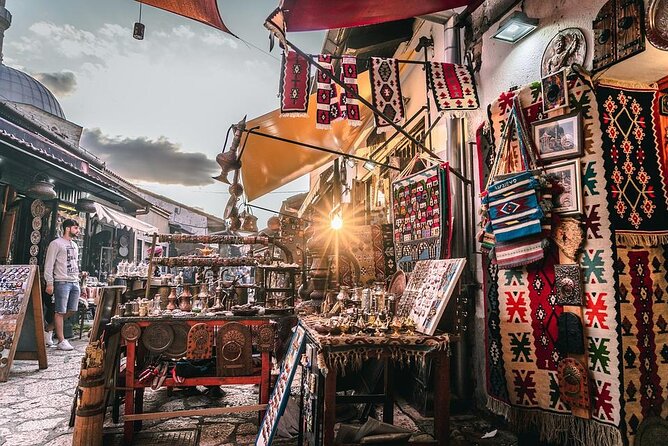
From Sebilj, you move to Kazandžiluk, Sarajevo’s traditional coppersmith street. The street is lined with distinctive copper and brass work, including coffee sets and household pieces. You are given around ten minutes to see the craft and hear why coffee matters so much in Bosnian custom.
One especially memorable detail from the experience is the connection between old metal and recent conflict. A local craftsman has turned mortar shell casings into vases, giving destructive objects a peaceful second use. It is a small but powerful example of how Sarajevo works with difficult memories instead of hiding them.
The coffee explanation is practical. You learn how Bosnian coffee is made and how it is drunk, which matters because the ritual is not identical to a standard espresso stop. This is not simply a caffeine break. It is a lesson in hospitality, conversation, and local habits.
You may also find useful shopping ideas here. The tour is not presented as a dedicated shopping trip, but Kazandžiluk gives you a chance to see the kind of copperwork that defines this part of town. If you buy something, remember that a decorative coffee set needs luggage space.
Morica Han and a proper coffee pause
Morica Han is one of the most atmospheric points on the route. This former caravanserai recalls the Ottoman period, when merchants and goods moved through Sarajevo along long-distance trade routes.
You spend about 25 minutes here, making it one of the tour’s main pauses. The setting gives the coffee lesson more meaning. Instead of drinking Bosnian coffee in an anonymous café, you sit in a place tied to the old trading life of the city.
The traditional serving style is part of the fun. Expect a small pot, a cup, and a careful approach to the grounds at the bottom. Your guide shows you how locals drink it, so you can enjoy the coffee without swallowing the sediment. Take your time, and do not expect this to taste like filtered coffee.
This is also where the private format helps. You can ask about coffee etiquette, Ottoman customs, or daily life in Sarajevo without waiting for a large group to move on. Guides Emina and Lamija have been singled out for making conversation easy and explaining local life in a friendly way, though your assigned guide may be someone else.
Bravadžiluk Street turns history into lunch
The food portion takes place around Bravadžiluk Street, an area known for restaurants serving Bosnian dishes and sweets. The formal itinerary gives only a few minutes to this street itself, but the food stop is clearly one of the central parts of the experience.
Your guide recommends traditional Bosnian specialties and explains what you are eating. The tastings have been described as generous, and one practical point matters here: this may feel closer to lunch than to a few little bites.
That is good value, but it affects scheduling. Do not book the tour immediately after a large meal. The food is meant to be enjoyed, not rushed, and you will get more from it if you arrive with room to try several things.
You receive recommendations for popular Bosnian foods and sweets rather than a generic international menu. That gives you a useful map for later meals. If you are unsure what to order during the rest of your stay, this early introduction can save you from choosing at random.
The food stop also adds balance to the historical material. Sarajevo’s story is not only about war, empires, and monuments. It is also about what people cook, serve, and share.
More coffee experiences:
- Sarajevo Uncovered: Old Town Tour with Coffee and Food Tasting
★ 5.0 · 12 reviews
A clock tower with an unusual time
The Old Sarajevo Clock Tower is a very short stop, listed at about two minutes. It sits near Gazi Husrev-beg Mosque and is known for showing a time system that may look strange if you expect an ordinary clock.
Your guide explains the reason for the unusual display. This is a good example of why a local guide adds value to a walking route. You could pass the tower, take a photograph, and never understand what makes it different.
Do not expect a long visit here. The point is the story, not an interior tour or an extended architectural inspection.
Three faiths close together
The route then moves toward Katedrala Srca Isusova, the Sacred Heart Cathedral. Built in a Neo-Renaissance style during Austro-Hungarian rule, it gives you another clear change in Sarajevo’s appearance and religious history.
You spend about ten minutes here, including time to see the statue of Pope John Paul II. The guide also discusses Sarajevo roses, the red markings used in the city to remember places where people were killed during the siege. That subject can be heavy, but it gives the city’s streets a human scale.
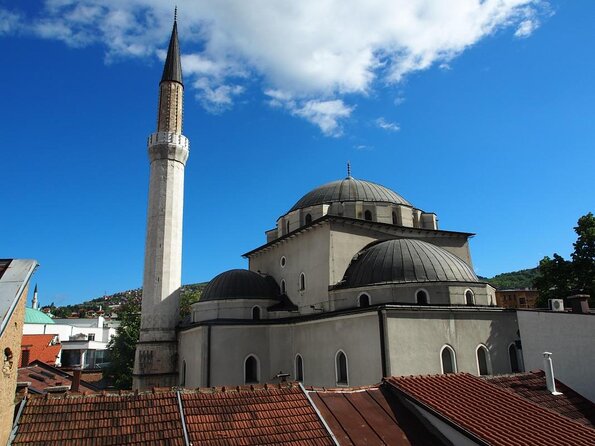
Gazi Husrev-beg Mosque follows, with another ten-minute stop. It is one of Sarajevo’s major Islamic buildings and one of the most important Ottoman landmarks in the old center. Modest dress and respectful behavior are sensible when visiting any place of worship. The provided tour information does not promise an interior visit at every stop, so follow your guide’s instructions.
The route also includes the Serbian Orthodox Cathedral, officially the Cathedral of the Nativity of the Theotokos. You spend about five minutes seeing its architecture and hearing the story of its construction.
Together, these stops show how close different religious traditions are within Sarajevo’s center. That proximity is one of the most meaningful features of the walk. You are not studying each building in isolation. You are seeing how several communities have shaped the same city.
Gazi Husrev Bey’s Bezistan and the old bazaar
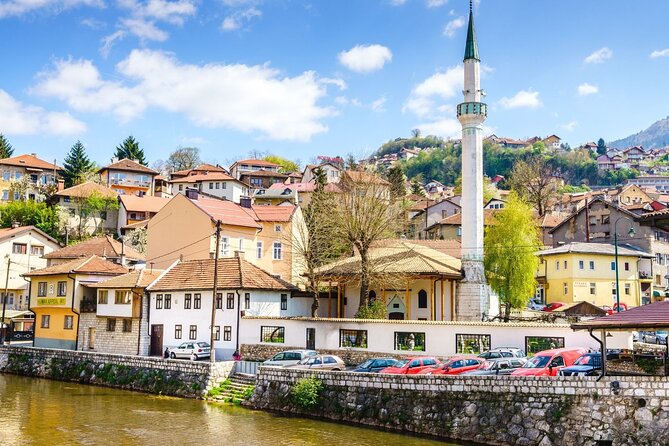
Gazi Husrev Bey’s Bezistan is an old Ottoman bazaar that preserves strong oriental features in its design. It fits naturally between the mosque and the other old-town streets.
The bazaar is a reminder that Sarajevo’s Ottoman character is not limited to one building. It appears in covered markets, lanes, shops, courtyards, fountains, and the way the old center is arranged.
This portion may appeal most to you if you prefer daily urban details over grand sights. The tour gives you context for the shopfronts and passages, so you can return later and explore at your own pace.
Because the walk includes many short stops, keep your expectations realistic. You will see and discuss several places, but this is not a museum tour with long interior visits. It is a guided introduction to the city center.
Latin Bridge and the event that changed Europe
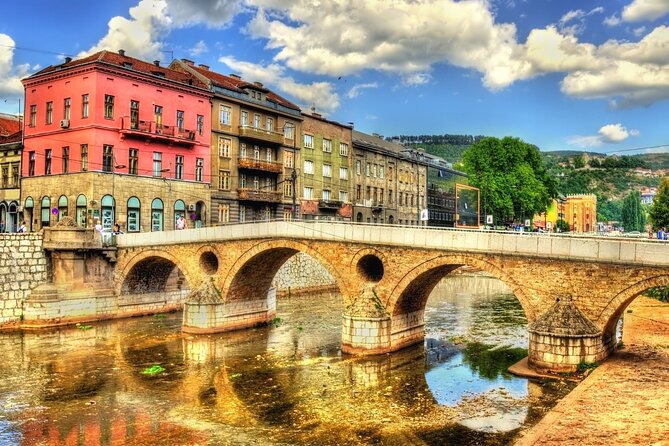
The walk finishes near Latin Bridge, associated with the assassination of Archduke Franz Ferdinand. That event in Sarajevo helped trigger World War I, making this one of the city’s most internationally known sites.
The listed stop lasts about ten minutes. Your guide explains what happened and why the consequences reached far beyond Sarajevo. The story works best when connected to the streets around it. You are not just looking at a plaque or bridge. You are standing at a place where a local event became a turning point for the world.
The end point is different from the start, so plan for that. The activity finishes near Latin Bridge rather than returning to City Hall. This is convenient if you want to continue exploring the old center, but it is worth knowing before you arrange transport or another timed activity.
What the private format adds
Private touring changes the feel of a short city walk. You do not have to match the pace of a large group, and you can ask for more detail when a subject catches your interest.
The guide can also respond to your level of background knowledge. If Sarajevo is new to you, the route offers a clear introduction. If you already know about the assassination or the siege, you can focus more on food, coffee, architecture, and present-day life.
The personal connection has been a major strength of this experience. Emina has been praised for easy conversation, strong explanations, and practical advice for later sightseeing. Lamija has also received warm praise for making the food and coffee stops both informative and enjoyable.
Those names are useful, but guide assignments can change. I would book this tour for the private attention and local perspective, not on the assumption that a particular guide is guaranteed.
Price, timing, and who gets the best value
At $66.54 per person, this is not the cheapest way to walk around Sarajevo. You can see many of the outdoor sights without paying an admission fee, and the route itself is compact.
The price makes more sense when you count what is bundled together: about two and a half hours, a private guide, historical interpretation, food tasting, and Bosnian coffee. You are also paying for orientation. A guide helps you understand why the buildings, streets, food, and rituals belong together.
I see the strongest value for a first visit, especially on your first day. You get a practical introduction to the old center and suggestions for what to eat and see later. The food portions can help cover a meal, which improves the value further.
The tour is less suited to you if you want long museum visits, a slow photography walk, or a full-day historical study. The route covers many subjects, so the experience favors variety over extended time at one monument.
The tour is offered in English and includes a mobile ticket. It is near public transportation, service animals are allowed, and most people can take part. Confirmation is provided when you book. Free cancellation is available up to 24 hours before the start time, while later cancellations and changes are not accepted. A minimum number of participants is required, and if that number is not met, you are offered another date or experience, or a full refund.
Should you book this Sarajevo food and coffee tour?
Book it if you want Sarajevo explained through food, faith, craft, and history, not just photographed from the outside. It is especially useful for a first day, for couples or families who want a private pace, and for anyone curious about Bosnian coffee and local dishes.
Skip it if you already know the old town well or prefer to explore without a set route. For most first-time visitors, though, the combination is hard to beat: a compact walk, generous food, a traditional coffee lesson, and a guide who can help you understand Sarajevo’s complicated past without turning the experience into a classroom.
FAQ
Where does the tour start?
It starts at Sarajevo City Hall, Brodac 1, Sarajevo 71000, Bosnia and Herzegovina.
Where does the tour finish?
The activity ends at a different location, near Latin Bridge.
How long does the tour last?
The tour lasts approximately two hours and 30 minutes.
How much does the tour cost?
The listed price is $66.54 per person.
Is this a private tour?
Yes. Only your group takes part in the activity.
What language is offered?
The tour is offered in English.
Is food included?
Yes. The experience includes tastings of traditional Bosnian food and sweets around Bravadžiluk Street.
Is Bosnian coffee included?
Yes. You learn how traditional Bosnian coffee is prepared and served, then taste it at Morica Han.
Can I cancel for a refund?
Yes. You can cancel at least 24 hours before the start time for a full refund. Cancellations or changes made less than 24 hours before the start time are not accepted.
More food experiences
- Delicious Sarajevo: Eat, Walk & Discover City Tour
★ 4.5 · 37 reviews - Eat, Pray, Love Tour
★ 4.5 · 32 reviews
More food and drink experiences
- Sarajevo: 4-Hour Food And Craft Tour
★ 5.0 · 70 reviews - LUKOMIR VILLAGE HIKE & TREK TOUR (nature, hike, food & panorama)
★ 5.0 · 11 reviews - Split/Trogir: Mostar and Medjugorje Tour with Wine Tasting
★ 4.5 · 282 reviews - Safari kayak adventure w BBQ & Beer
★ 5.0 · 34 reviews
Just added around Sarajevo
- Srebrenica Genocide Tour from Sarajevo★ 4.5 · 3 reviews
- Mountain Village Lukomir Full Day Adventure Tour★ 5.0 · 3 reviews
- MTB Bjelasnica – Lukomir★ 5.0 · 3 reviews
- Herzegovina Tour from Sarajevo: Mostar, Počitelj, Blagaj, Kravice★ 5.0 · 3 reviews
- Sarajevo Under Siege: A City’s Struggle & Survival Tour★ 5.0 · 3 reviews
- Beautiful Bosnia 8 Days Tour Package★ 5.0 · 3 reviews
- Bosnian Kingdom Capitals: Travnik & Jajce Tour from Sarajevo★ 5.0 · 3 reviews
- Walking Tour in Sarajevo★ 5.0 · 3 reviews
Walking Tours in Sarajevo, compared.
Delicious Sarajevo: Eat, Walk & Discover City Tour
Read our review →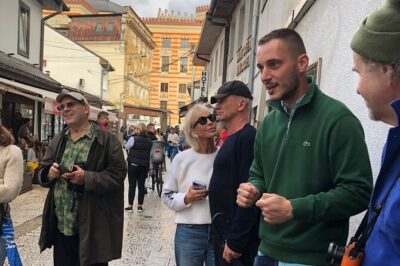
PROFESSIONAL SARAJEVO WALKING TOUR – With guide who guided STING!
Read our review →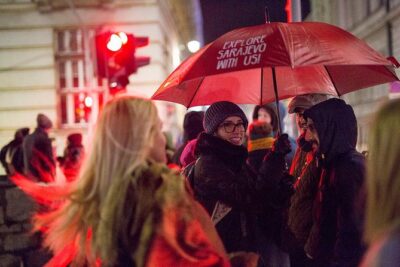
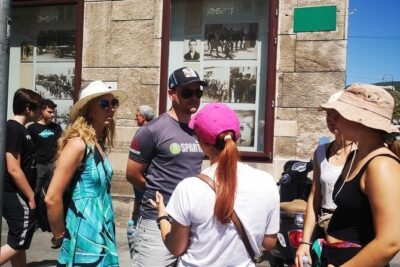
Sarajevo genuine walking tour: Steps through history
Read our review →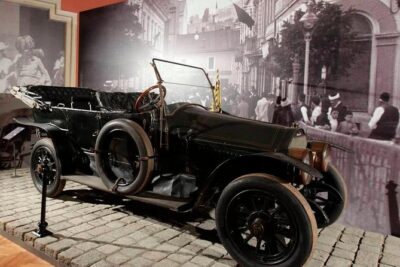
Browse the lists this tour appears in