
REVIEW · WALKING TOURS IN SARAJEVO
Sarajevo Essential Full Walking Tour
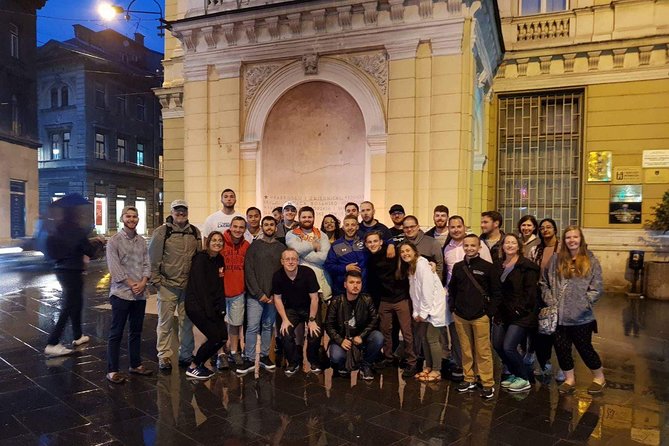
Sarajevo reveals itself street by street. This $18.15 walking tour connects Ottoman markets, Austro-Hungarian buildings, religious landmarks, and Sarajevo’s war memorials in about two hours. I like the clear route from Sacred Heart Cathedral to Latin Bridge, and I like the chance to hear local context instead of simply ticking off monuments. The main consideration is the possible group size, which can reach 50 people, so the experience may not always feel as personal as the small-group description suggests.
I also like that the route includes both famous sights and easy-to-miss places such as the Sarajevo Meeting of Cultures, Taslihan, and a working coppersmith street. Guides such as Adnan, known as Ado, have been praised for being easy to follow and open to questions. You should allow extra time if you want to enter the museums or City Hall, since admission is not included.
In This Review
- Key points to know before you book
- Why this short walk works so well in Sarajevo
- Starting at Sacred Heart Cathedral
- Sarajevo Meeting of Cultures and the Jewish Museum
- Gazi Husrev-beg Mosque and the Ottoman center
- Sebilj and Kazandziluk, the most atmospheric stretch
- City Hall, the Spite House, and the Miljacka River
- Emperor’s Mosque and the shift toward modern Sarajevo
- Latin Bridge and the Sarajevo assassination
- Orthodox Sarajevo and the multicultural monument
- Sarajevo Roses and the city’s painful recent past
- Timing, group size, and meeting point
- Who will get the most from this tour
- Should you book the Sarajevo Essential Full Walking Tour?
- FAQ
- How much does the Sarajevo Essential Full Walking Tour cost?
- How long does the walking tour last?
- Where does the tour start?
- Where does the tour end?
- Is hotel pickup available?
- Is the tour offered in English?
- Are admission tickets included?
- Is food included?
- What is the cancellation policy?
Key points to know before you book

- The route covers three major faith traditions: Catholic, Muslim, and Orthodox landmarks appear within a compact central walk.
- Latin Bridge puts Sarajevo’s role in European history into focus: The 1914 assassination happened only a few meters from the bridge.
- Kazandziluk is more than a photo stop: Coppersmiths still practice their craft along this old street.
- The tour costs $18.15 per person: That is strong value if you want a useful introduction before exploring on your own.
- The planned stops add up to about two hours: The advertised duration is one to two hours, depending on the pace and group.
- Pickup can be arranged in advance: The standard meeting point is the Spirit Tours office at Ferhadija 19.
Why this short walk works so well in Sarajevo
Sarajevo is compact, but its story is not simple. In a few city blocks, you can move from a Catholic cathedral to an Ottoman mosque, pass an Orthodox church, browse a covered bazaar, and reach the spot tied to the outbreak of the First World War.
That mix is the chief reason I like this tour. A solo walk can show you the buildings, but a guide can explain why they sit so close together and how different communities shaped the city. The route gives you a useful framework without asking you to spend half a day in a museum.
The tour lasts about one to two hours. That makes it a good first activity after arriving in Sarajevo, especially if you want to get your bearings before choosing where to eat, shop, or return for a longer visit.
The price is also sensible. At $18.15, you are paying less for entry tickets and more for a local explanation of the city. Since most stops are viewed from outside and admission is free at many locations, the value depends on the guide. A strong guide makes this a bargain. A rushed guide would make it feel like a fast roll call of buildings.
More Walking Tours in Sarajevo
- Sarajevo: 2 Hours Old Town Walking Tour With Local Guide
★ 5.0 · 505 reviews - Private Walking Tour, Food Tasting and Bosnian Coffee in Sarajevo
★ 5.0 · 255 reviews - Sarajevo Grand Walking Tour
★ 5.0 · 232 reviews
Starting at Sacred Heart Cathedral
The walk begins at the Cathedral of Jesus’ Sacred Heart, Sarajevo’s largest Catholic church. Built in 1889 in Neo-Gothic style, it is the seat of the Archdiocese of Vrhbosna.
You get about ten minutes here, enough to see the exterior and understand its place in the city. The cathedral is a useful opening stop because it introduces Sarajevo’s Catholic community before the route moves toward Ottoman and Orthodox landmarks.
Admission is free. If you want a quiet look inside, the short scheduled stop may not leave much time, so listen carefully at the beginning and note anything you want to revisit later.
Sarajevo Meeting of Cultures and the Jewish Museum
The next section brings two important ideas together. At the Sarajevo Meeting of Cultures on Ferhadija Street, a marked point shows where two major cultural zones of the city meet. It is a small landmark, but it helps you notice the change in architecture, shops, and street character as you walk.
The tour also passes the Museum of the Jews of Bosnia and Herzegovina, located inside Sarajevo’s oldest synagogue. The stop is only about five minutes, and admission is not included. That means you should treat it as an introduction rather than a full museum visit.
If Jewish heritage is a priority for you, ask the guide how to return later and give the museum more time. The walking tour can point out the site, but it cannot replace a proper visit.
Gazi Husrev-beg Mosque and the Ottoman center
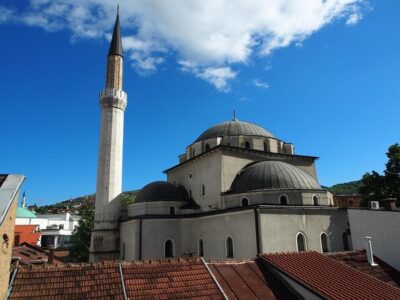
The Gazi Husrev-beg Mosque is one of the major stops. Built in the 16th century, it is the largest historic mosque in Bosnia and Herzegovina and one of the finest Ottoman structures in the Balkans.
The guide’s explanation matters here. The mosque is not just a handsome building in the middle of the old town. It is part of the larger religious, commercial, and charitable complex created around Gazi Husrev-beg’s endowment.
You get around ten minutes at the mosque. Admission is listed as free, though visitors should follow any local rules about entering religious buildings. Modest clothing and respectful behavior are sensible choices.
Nearby, the Gazi Husrev-beg Bezistan gives you a different view of the same Ottoman center. This covered bazaar was built in 1555 and still serves its original commercial purpose. Its narrow interior and shops help you understand how trade worked in the old city.
The route also includes Taslihan, built in 1543 as part of Gazi Husrev-beg’s waqf. It once included a fountain, mosque, courtyard, shops, and storage rooms. Fires damaged it badly, so what you see today is more fragment than complete building. That is precisely why a guide helps. Without context, it can look like an ordinary patch of old stone.
More walking tours:
- Delicious Sarajevo: Eat, Walk & Discover City Tour
★ 4.5 · 37 reviews - PROFESSIONAL SARAJEVO WALKING TOUR – With guide who guided STING!
★ 5.0 · 29 reviews - Sensational Sarajevo Sunset Walking Tour
★ 4.5 · 26 reviews - Sarajevo genuine walking tour: Steps through history
★ 5.0 · 22 reviews
Sebilj and Kazandziluk, the most atmospheric stretch
Baščaršija Square is home to the Sebilj, an Ottoman-style wooden fountain built in 1753 by Mehmed Pasha Kukavica. It is one of Sarajevo’s most recognizable public landmarks.
The scheduled stop is brief, only about five minutes. You will have time to take in the fountain and square, but the area may tempt you to linger. If you want photographs or a closer look at the surrounding shops, plan to return after the tour.
For me, Kazandziluk is one of the most worthwhile parts of the route. This is the old coppersmith street, where the traditional craft is still practiced. The street has kept its historic appearance, and the metalwork gives the stop a more direct connection to daily life than a monument viewed from a pavement.
A past tour experience highlighted the chance to visit a coppersmith’s shop and see examples of decorative objects being made. That is a useful reminder to watch the shopfronts closely rather than treating the street as a quick photo stop. The ten-minute visit may be short, but it can give you one of the clearest glimpses of Sarajevo’s working traditions.
City Hall, the Spite House, and the Miljacka River
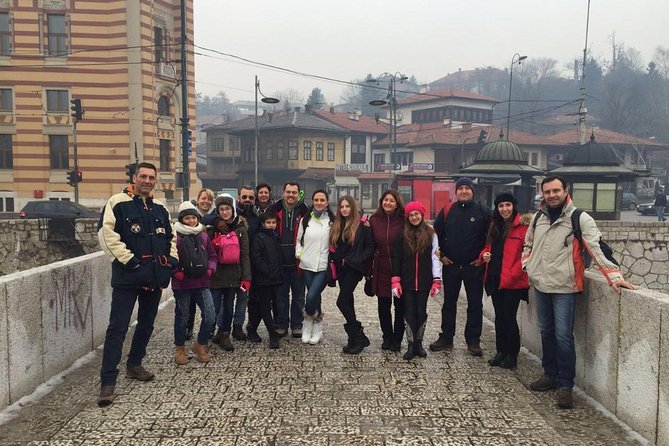
Sarajevo City Hall, or Vijećnica, is the grand Austro-Hungarian building on the route. Its elaborate design reflects the late 19th-century period when Sarajevo was under Austro-Hungarian rule.
The building is important for more than its appearance. It represents another layer of Sarajevo’s identity, one that arrived after the Ottoman period and added new public buildings, roads, and institutions to the city.
Admission is not included, so the ten-minute stop is mainly an exterior visit unless you choose to pay separately and return later. The tour does not provide enough time for a full interior exploration.
Near Cumurija Bridge, you will hear the story of the Spite House. The owner supposedly refused to move when City Hall was being built, so the house was relocated across the river. Its stubborn name became part of Sarajevo’s local character, and the building now houses a national restaurant.
This is a small story, but it adds humor to a route that includes plenty of heavy subjects. It also shows how the city’s grand official projects collided with ordinary property owners.
Emperor’s Mosque and the shift toward modern Sarajevo
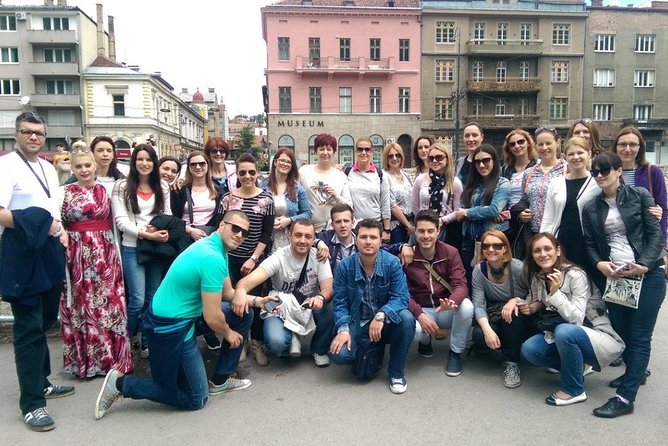
The Emperor’s Mosque is described as Sarajevo’s oldest mosque and one of the oldest in Bosnia and Herzegovina. It is linked to Isa Bey Ishaković, regarded as the founder of Sarajevo, and was built soon after the city’s founding in 1462 in honor of Sultan Mehmed II.
The stop lasts about five minutes. That is enough for a short explanation and exterior view, but not a detailed architectural study.
The route then returns toward the commercial center and later passes Hotel Europe. This Austro-Hungarian building sits close to the old town and helps show how Sarajevo’s Ottoman core and later European city developed side by side.
I appreciate this part of the walk because it prevents the city from being reduced to one period. Sarajevo is not only Ottoman, not only Austro-Hungarian, and not only connected to the 1990s war. The sequence of stops makes those layers visible within a very short distance.
Latin Bridge and the Sarajevo assassination
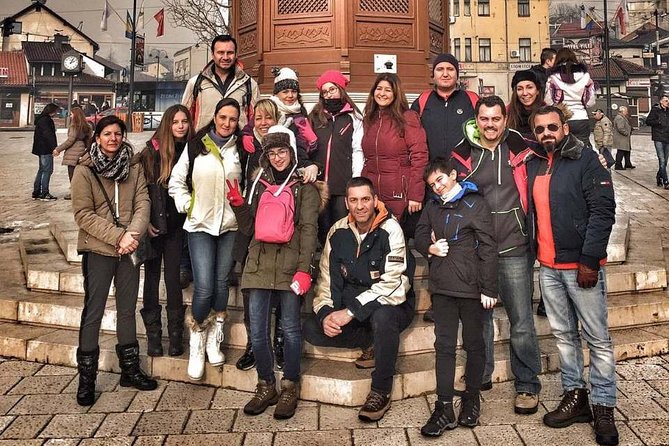
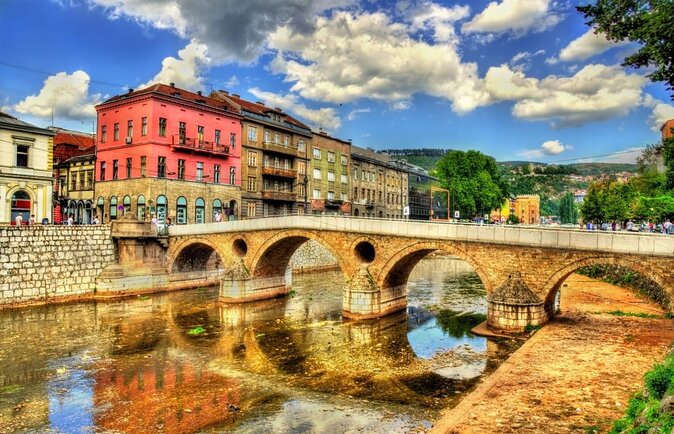
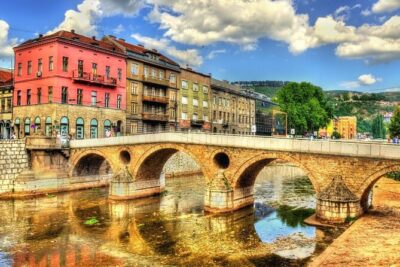
Latin Bridge is the stop most closely tied to the beginning of the First World War. Gavrilo Princip assassinated Archduke Franz Ferdinand and his wife, Sophie, near the bridge in 1914.
The guide can clarify the geography here, which is useful because the event is often described in broad terms. Princip was only a few meters from the bridge when he carried out the assassination. The location is surprisingly ordinary, and that contrast makes the story easier to grasp.
You get about ten minutes at the bridge. It is free to view, and the stop works well even if you have little interest in military history. The event changed Europe, yet it happened in a small, familiar urban setting.
If you want more detail on the assassination, this tour gives you the basic setting but not a long specialist lecture. Think of it as a starting point for a later museum visit.
Orthodox Sarajevo and the multicultural monument
The Cathedral Church of the Nativity of the Theotokos is the largest Serbian Orthodox church in Sarajevo and one of the largest in the Balkans. Its inclusion is important because it completes the tour’s introduction to the city’s main Christian and Muslim communities.
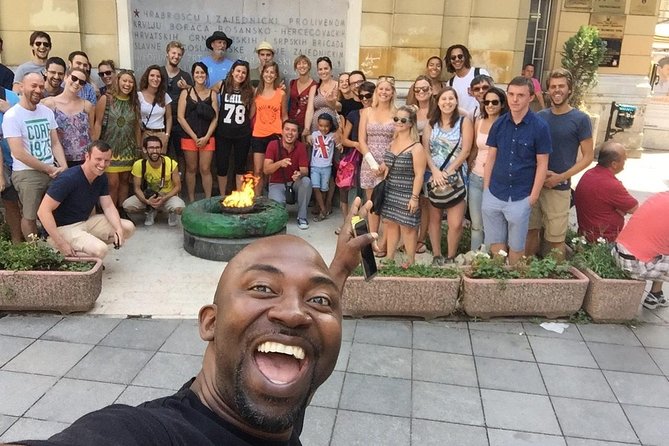
The next stop, the Monument to the Multiethnic Human, makes that point directly. It sits between the Catholic cathedral, the Muslim mosque, and the Orthodox church. Its message is that the multicultural person helps build the world, and the inscription appears in Italian and Bosnian.
This is one of the most useful stops for understanding the city’s central idea. You are not being shown isolated religious buildings. You are being shown how closely different traditions have existed within the same urban space.
The five to ten-minute visits are short, but the locations are close together. The guide’s explanation should help you connect them rather than view them as separate photo opportunities.
Sarajevo Roses and the city’s painful recent past
A Sarajevo Rose is a concrete scar made by a mortar shell explosion and later filled with red resin. These memorials mark places where people died during the siege of Sarajevo.
The tour includes a Sarajevo Rose for about ten minutes. It is a quiet stop, and it changes the tone of the walk. Earlier sites point to centuries of religious and political change. This one brings the city’s recent suffering into the pavement beneath your feet.
The memorial is simple, but it asks you to look down and pay attention. You do not need a long speech to understand that the war is not a distant subject in Sarajevo. Its marks remain part of ordinary streets.
Because the overall tour is short, this stop offers an introduction rather than a full account of the siege. If the subject matters deeply to you, ask the guide for suggestions for further visits after the walk.
Timing, group size, and meeting point
The standard starting point is the Spirit Tours office at Ferhadija 19 in central Sarajevo. The tour ends back at the same meeting point, which is convenient if you want to continue shopping or eating in the old town.
Pickup can be arranged from a hotel, apartment, or hostel if requested in advance. The normal hours shown for the activity are Monday through Sunday, 9:00 a.m. to 5:00 p.m.
The tour is offered in English and uses a mobile ticket. Confirmation is provided when you book. Service animals are allowed, and the meeting point is near public transportation.
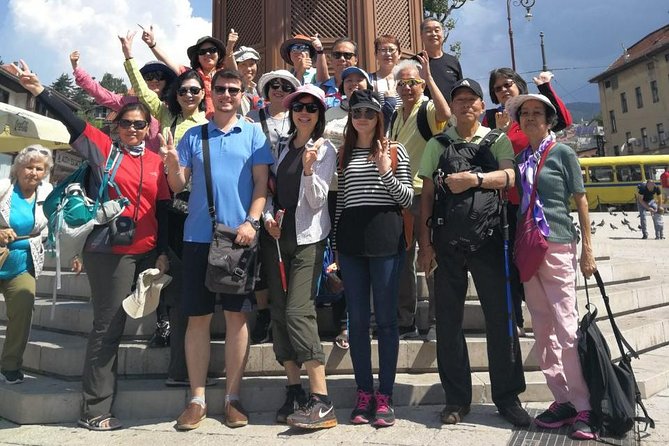
One detail deserves attention: the tour is described as a small-group walk, but the maximum group size is 50 people. You might get a very small group, as happened when a couple had guide Ado to themselves, or you might walk with a much larger crowd. If asking questions is important to you, arrive ready to stay near the guide.
The planned stops take about two hours in total. Wear comfortable shoes, since the experience is entirely centered on walking between central sites. Food and drinks are not included, so use the end of the tour as a good time to choose a café or meal in Baščaršija.
Who will get the most from this tour
I would recommend this walk to anyone visiting Sarajevo for the first time. It gives you the city’s basic structure quickly and helps you decide which places deserve a second visit.
It suits you particularly well if you want:
- A short introduction before exploring independently
- A clear explanation of Sarajevo’s Ottoman and Austro-Hungarian layers
- An easy way to connect Catholic, Muslim, Jewish, and Orthodox sites
- Local stories about places such as the Spite House
- A guide who can answer questions about daily life and local customs
- A low-cost activity with many free stops
It is less suitable if you want long interior visits. The Jewish Museum and City Hall charge admission, and the schedule does not include those costs or allow much time inside. It is also not the right choice if you want an in-depth study of the siege or the First World War.
The strongest guide reports point to clear explanations and a friendly question-and-answer style. Adnan, or Ado, is one guide to hope for, though no specific guide is guaranteed. A female guide has also been praised for making the culture and past easy to understand in a short time.
Should you book the Sarajevo Essential Full Walking Tour?
Book it if you want an affordable, well-planned introduction to Sarajevo’s central sights. For $18.15, the route covers far more than a basic old-town stroll, including the cathedral, mosque, bazaar, City Hall, Latin Bridge, Orthodox church, coppersmith street, and Sarajevo Rose.
Keep your expectations realistic. This is a fast orientation walk, not a full museum tour. Ask questions, stay close to the guide, and return later to the places that catch your interest.
Free cancellation is available if you cancel at least 24 hours before the start time. A minimum number of participants is required, and if that minimum is not reached, you can receive a different date or a full refund. For a first look at Sarajevo, the balance of price, range, and short duration makes this an easy tour to recommend.
FAQ
How much does the Sarajevo Essential Full Walking Tour cost?
The tour costs $18.15 per person.
How long does the walking tour last?
The experience lasts approximately one to two hours.
Where does the tour start?
It starts at the Spirit Tours office, Ferhadija 19, Sarajevo 71000, Bosnia and Herzegovina.
Where does the tour end?
The activity ends back at the meeting point.
Is hotel pickup available?
Hotel, apartment, or hostel pickup can be organized if requested in advance.
Is the tour offered in English?
Yes. The tour is offered in English.
Are admission tickets included?
Admission is free at many listed stops. Tickets for the Museum of the Jews of Bosnia and Herzegovina and Sarajevo City Hall are not included.
Is food included?
No. Food and drinks are not included.
What is the cancellation policy?
You can cancel at least 24 hours before the start time for a full refund. Cancellations or changes made less than 24 hours before the start time are not accepted for a refund.
Just added around Sarajevo
- Srebrenica Genocide Tour from Sarajevo★ 4.5 · 3 reviews
- Mountain Village Lukomir Full Day Adventure Tour★ 5.0 · 3 reviews
- MTB Bjelasnica – Lukomir★ 5.0 · 3 reviews
- Sarajevo Under Siege: A City’s Struggle & Survival Tour★ 5.0 · 3 reviews
- Herzegovina Tour from Sarajevo: Mostar, Počitelj, Blagaj, Kravice★ 5.0 · 3 reviews
- Beautiful Bosnia 8 Days Tour Package★ 5.0 · 3 reviews
- Bosnian Kingdom Capitals: Travnik & Jajce Tour from Sarajevo★ 5.0 · 3 reviews
- Walking Tour in Sarajevo★ 5.0 · 3 reviews
Walking Tours in Sarajevo, compared.
Private Walking Tour, Food Tasting and Bosnian Coffee in Sarajevo
Read our review →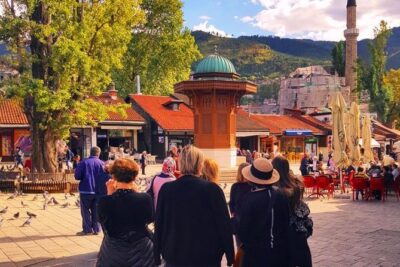
Delicious Sarajevo: Eat, Walk & Discover City Tour
Read our review →
PROFESSIONAL SARAJEVO WALKING TOUR – With guide who guided STING!
Read our review →
Sarajevo genuine walking tour: Steps through history
Read our review →
Browse the lists this tour appears in