
REVIEW · WALKING TOURS IN SARAJEVO
Sarajevo Grand Walking Tour
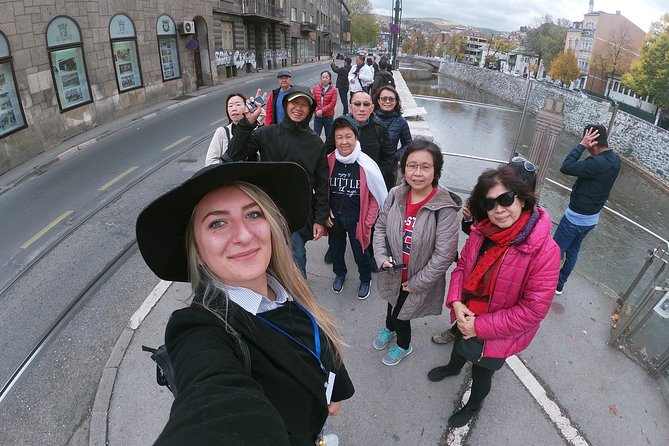
Sarajevo tells its story one street at a time. The Sarajevo Grand Walking Tour gives you a clear introduction to that story, moving from the Latin Bridge and the First World War to Ottoman mosques, Austro-Hungarian churches, Jewish heritage, and the scars of the 1990s war. I especially like the way it connects Sarajevo’s many faiths and empires, and I like that local guides add personal views rather than simply reciting dates. The main consideration is pace: three hours on foot, with many stops, can feel full on a cold or wet day.
At $20.57 per person, this is a good-value orientation tour if you are new to Sarajevo. Guides such as Ilma, Hana, Suad, Haris, Emina, Denis, and Alem have been praised for making difficult subjects easy to follow, while also offering useful suggestions for food and coffee. Groups can reach 30 people, so your experience may feel lively and social, or less personal than a private walk.
In This Review
- Key points to know before you book
- Why this walk is useful on your first day
- Latin Bridge and the first shock of modern Europe
- Mosques, churches, and Sarajevo’s shared city center
- The Spite House and Sarajevo City Hall
- Kovači Cemetery and the memory of the 1990s war
- Baščaršija, metalwork, and the city’s best-known fountain
- Gazi Husrev Bey’s Mosque and the meeting of cultures
- Jewish, Catholic, and Orthodox Sarajevo
- Markale Market and the Eternal Flame
- What the $20.57 price really gives you
- Who should book this Sarajevo walk?
- Should you book the Sarajevo Grand Walking Tour?
- FAQ
- How long does the Sarajevo Grand Walking Tour last?
- Where does the tour begin and end?
- What language is the tour offered in?
- Is lunch included?
- How many people can join the tour?
- Can I cancel for a full refund?
Key points to know before you book
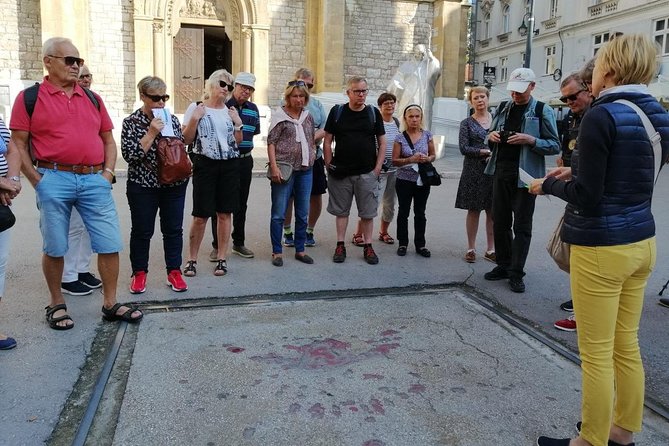
- The route crosses Sarajevo’s major cultural boundaries: You move between Ottoman, Austro-Hungarian, Jewish, Catholic, Orthodox, and modern Bosnian landmarks.
- The Latin Bridge sets the historical tone: The assassination of Archduke Franz Ferdinand is explained at the very place where it happened.
- Personal stories add weight: Guides may discuss family memories and the 1992 to 1995 war alongside wider political history.
- You cover a lot in three hours: Expect a steady walk through the Old Town and central Sarajevo, with many brief stops.
- The best time to take it is early in your stay: You can use the guide’s food, coffee, and sightseeing advice for the rest of your visit.
- It is an economical group tour: The price is modest, but lunch, coffee, taxes, and any optional admission costs are not included.
Why this walk is useful on your first day
Sarajevo can be confusing at first. Its compact center shifts quickly from Ottoman lanes to Austro-Hungarian avenues, then to grand religious buildings and markets shaped by several communities. I like having a guide explain those changes as you walk, because the city’s layout becomes a kind of visual history lesson.
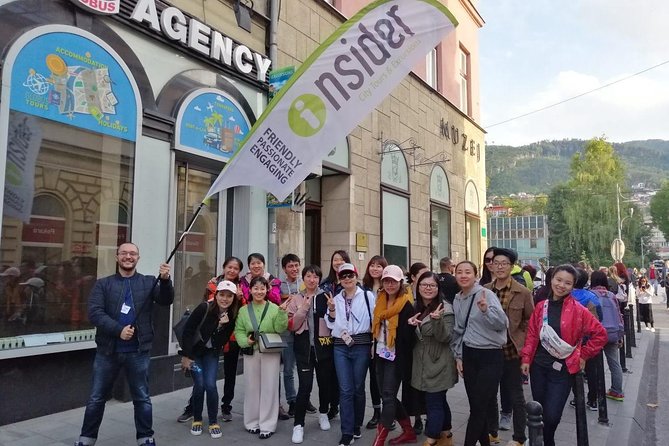
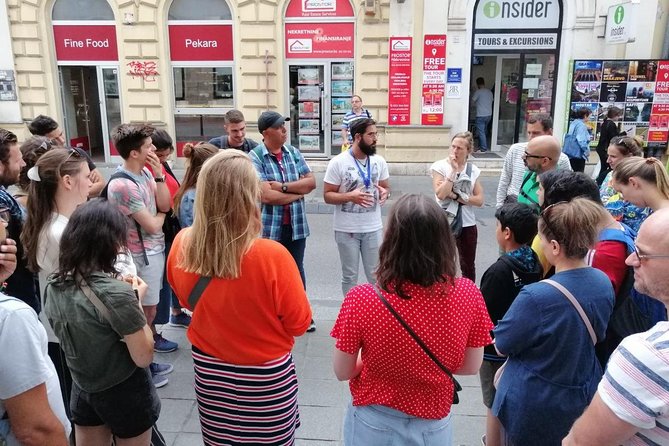
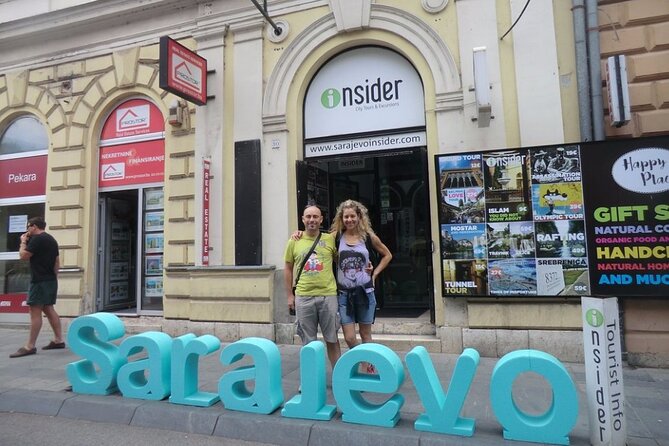
The tour begins at Sarajevo Insider, at Zelenih beretki 30, and ends back at the same meeting point. That makes the outing easy to fit into a first or second day in town. You receive a city map, and several guides have offered practical recommendations for local restaurants, coffee, and places worth returning to.
The tour is offered in English and lasts about three hours. Some walks have run closer to three and a half hours, depending on the group and questions. You should allow enough time afterward rather than booking another fixed activity immediately.
The route is generally manageable and largely flat through the central areas, but it is still a proper walking tour. You will be on your feet for hours, and the schedule includes many short explanations rather than long indoor visits. Wear comfortable shoes and dress for the forecast. One guide specifically advised warm clothing, which is sensible in Sarajevo’s cooler seasons.
More Walking Tours in Sarajevo
- Sarajevo: 2 Hours Old Town Walking Tour With Local Guide
★ 5.0 · 505 reviews - Private Walking Tour, Food Tasting and Bosnian Coffee in Sarajevo
★ 5.0 · 255 reviews - Sarajevo Essential Full Walking Tour
★ 5.0 · 198 reviews
Latin Bridge and the first shock of modern Europe
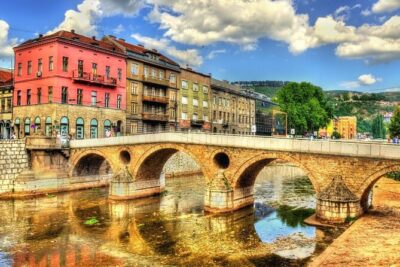
The Latin Bridge is the opening history lesson. Nearby, Archduke Franz Ferdinand of Austria and his wife Sophie were assassinated in 1914. The event helped set off the First World War, so this modest riverside location carries a remarkable amount of global importance.
The stop lasts about 12 minutes. That is enough time for the guide to explain the assassination and place it within Sarajevo’s political tensions, but not enough for a long museum-style treatment. I find this a good way to begin because it shows how a local street can affect the whole world.
From there, the walk reaches At Mejdan Park beside the Miljacka River. It is a short three-minute stop, more about setting and orientation than a major sight. The green space gives you a brief change of pace before the route turns toward Sarajevo’s religious landmarks.
Mosques, churches, and Sarajevo’s shared city center
The Emperor’s Mosque is one of the city’s oldest mosques and an important marker of Sarajevo’s Ottoman and Islamic past. The stop is brief, about two minutes, so you should not expect a full architectural visit. The value comes from seeing where the mosque fits into the city and hearing how Ottoman rule shaped Sarajevo.
The Franciscan Church of Saint Anthony provides a quick contrast. Its neo-Gothic design looks very different from the Ottoman buildings nearby, and that contrast is the point. Sarajevo’s identity is not based on one tradition. You see several religious communities in a small area, often within a few minutes of one another.
The Sarajevo Brewery follows, another short stop. It is described as Bosnia’s oldest industrial complex and remains associated with traditional beer production. This part of the walk gives you a glimpse of the city beyond monuments and places of worship. Industry, daily life, and survival all belong to Sarajevo’s story.
The route also includes the Bosnian House Bicakcic-Hadzisabanovic, a modernist architectural site with historical importance. The schedule does not give a set stop time here, so the guide may use it as a passing point or short explanation. It is a useful reminder that Sarajevo is not only Ottoman and Austro-Hungarian. Modern architecture also forms part of its character.
The Spite House and Sarajevo City Hall
The House of Spite is one of the city’s best small stories. When the authorities planned Sarajevo City Hall, the building project threatened a house on the opposite side of the river. The owner refused to surrender it and eventually had the house rebuilt, brick by brick, across the river.
The stop lasts about three minutes. That is short, but the story is memorable and easy to understand. I like these smaller tales because they make the city feel human. Grand political events can be hard to picture, while one stubborn homeowner gives you an immediate sense of Sarajevo’s independent streak.
Next comes Sarajevo City Hall, known for its neo-Moorish design and its blend of Eastern and Western influences. You have about ten minutes here, making it one of the longer architectural stops. The building is visually striking, but its importance is also tied to the city’s Austro-Hungarian period and its role in Sarajevo’s cultural life.
The tour is strongest when it places these buildings side by side. The Spite House is intimate and defiant. City Hall is grand and official. Together, they show two sides of the same city.
More walking tours:
- Delicious Sarajevo: Eat, Walk & Discover City Tour
★ 4.5 · 37 reviews - PROFESSIONAL SARAJEVO WALKING TOUR – With guide who guided STING!
★ 5.0 · 29 reviews - Sensational Sarajevo Sunset Walking Tour
★ 4.5 · 26 reviews - Sarajevo genuine walking tour: Steps through history
★ 5.0 · 22 reviews
Kovači Cemetery and the memory of the 1990s war
At Kovači Cemetery, the mood changes. This national memorial honors Bosnia’s defenders from the 1992 to 1995 war. The stop lasts about three minutes, but the subject may receive more explanation depending on your guide and the questions in the group.
This is one of the points where a guide’s personal connection can matter. Several guides have shared family perspectives and personal memories when discussing the war. One guide was praised for being old enough to remember the conflict, yet still speaking with optimism about Bosnia’s future. That combination of direct experience and hope can give the subject a human scale.
The tour continues along Kovači Street, where Ottoman-era character and local shops offer a less formal view of the neighborhood. I appreciate this transition. You are not left with war memorials alone. You see a living street where ordinary life continues beside places of remembrance.
Baščaršija, metalwork, and the city’s best-known fountain
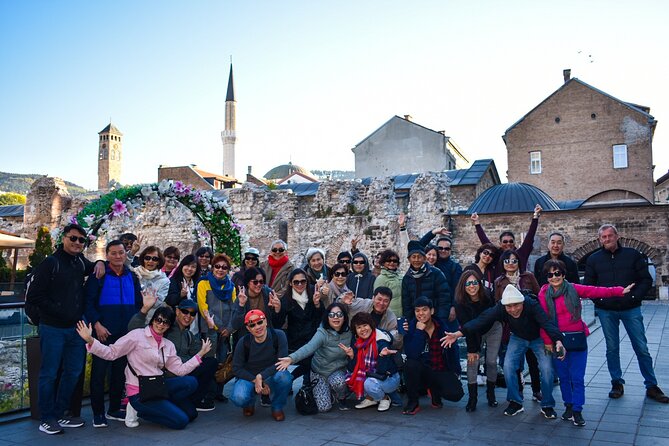
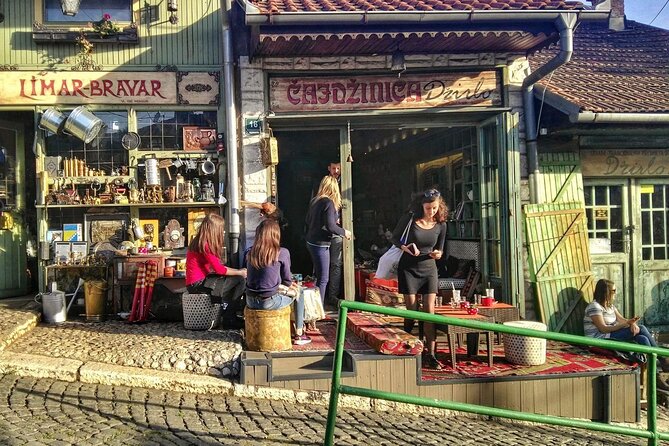
Baščaršija is the center of old Sarajevo and receives about 15 minutes on the route. This is where the walk feels most traditionally Ottoman, with market lanes, small shops, and a strong sense of the city’s trading past.
The nearby Bravadžiluk and Kazandžiluk streets focus on food and craft. Kazandžiluk is linked to traditional copper and metalwork, while Bravadžiluk is associated with local food. The guide can help you notice details you might pass without understanding, then point you toward places to eat later.
The Sebilj Fountain is another five-minute stop. It is one of Sarajevo’s most recognizable meeting points, and local legend says that anyone who drinks from it will return to the city. You can treat that as folklore, but it is a pleasant custom and an easy place to remember.
Morica Han, the city’s last Ottoman inn, adds another layer. The five-minute stop lets you picture the role of caravan inns in commercial Sarajevo. It is not just another old building. It helps explain how merchants, visitors, and goods once moved through the city.
Gazi Husrev Bey’s Mosque and the meeting of cultures
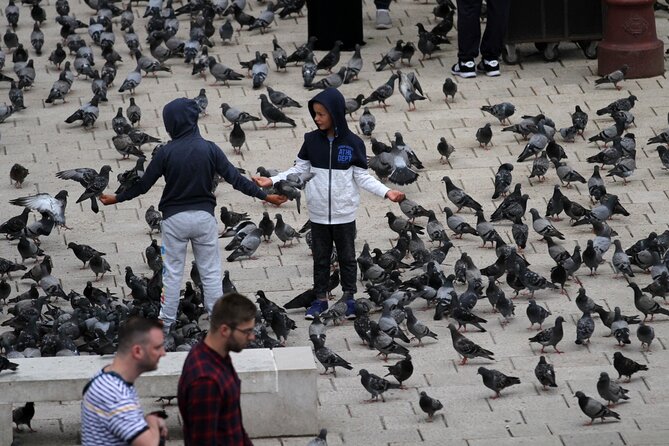
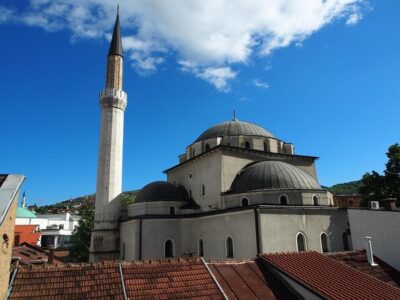
Gazi Husrev Bey’s Mosque receives about ten minutes, one of the longer stops in the Old Town. This 16th-century mosque is one of Sarajevo’s major Islamic landmarks and a calm counterpoint to the market streets outside.
You should dress respectfully around religious sites, and your guide can explain the customs and history in context. One guide’s discussion of Muslim faith was particularly helpful for a visitor who wanted a clearer understanding of Islam in Bosnia. That educational side of the tour is worthwhile because it moves beyond architecture and addresses how religion shapes local life.
At the Sarajevo Meeting of Cultures marker, the route reaches a symbolic dividing line between the Ottoman Old Town and the Austro-Hungarian center. You can cross the street and feel the shift in architecture almost immediately. The stop lasts only three minutes, but it gives you a simple visual idea of how Sarajevo’s past is layered rather than neatly separated.
Jewish, Catholic, and Orthodox Sarajevo
The Museum of the Jews of Bosnia and Herzegovina, also known as the Old Jewish Temple, introduces Sarajevo’s Sephardic Jewish heritage. The stop lasts about five minutes and includes mention of the Sarajevo Haggadah, an important illuminated manuscript.
This is a small but essential part of the city story. Sarajevo is often presented through Ottoman and wartime history, yet Jewish life has also shaped the city for centuries. The stop helps you understand the wider pattern of coexistence that the tour returns to throughout the morning.
The Cathedral of the Sacred Heart follows. Often called Sarajevo’s Notre Dame, it is a large Catholic landmark in the central city. The five-minute visit is enough to admire the exterior and understand its place among the surrounding buildings.
The Serbian Orthodox Cathedral adds another clear contrast. Its domes and interior murals make it one of the route’s most notable religious buildings. Again, the scheduled five minutes means this is not an extended church tour. Still, seeing Catholic and Orthodox landmarks alongside mosques and the Jewish temple is one of the strongest reasons to take this walk.
The route does not pretend Sarajevo’s communities have always lived without tension. Instead, it gives you the buildings, dates, and conflicts needed to understand both the city’s shared life and its painful divisions.
Markale Market and the Eternal Flame
Markale City Market brings you back to everyday Sarajevo. You can expect a short five-minute stop among local produce, food, and market activity. After so many historical sites, this is a useful reminder that the city is not an open-air museum.
The final major stop is the Eternal Flame, a five-minute visit at a monument honoring victims of the Second World War. Its flame symbolizes remembrance and resilience. Ending here gives the route a thoughtful close, linking wartime memory from the 1940s with the later conflicts discussed at Kovači.
Because the tour returns to the original meeting point, you finish in a useful central area rather than being left at an unfamiliar edge of town. The included city map can help you continue exploring on your own.
What the $20.57 price really gives you
At $20.57, the tour costs less than many guided city experiences, especially for a three-hour route with an English-speaking guide and a map. You are paying mainly for context and access to local interpretation, not for meals, transport, or elaborate included admissions.
That distinction matters. Most stops are viewed from public areas, and lunch, coffee, tea, all fees, and taxes are excluded. If you want a private guide, there is an upgrade option, which may suit you if you care about setting the pace or asking many questions.
The maximum group size is 30. A group that large can make it harder to hear in busy streets, and it may limit personal conversation. On the other hand, some departures may be much smaller. One experience ended up with only two people and an English-speaking guide, while another was a solo booking. A small group can feel personal, though one solo participant found the guide’s delivery too mechanical. That is a fair reminder that group size alone does not guarantee a better experience.
The strongest pattern is clear: guides are often praised for explaining complex history, answering questions, and adding food recommendations. Haris, Suad, Hana, Denis, Fariz, Kenan, Alem, Ilma, Emina, Masha, Merjim, Alex, Elvis, and others have all received strong individual praise. Your assigned guide will vary, but the company has a wide pool of well-regarded English-speaking guides.
Who should book this Sarajevo walk?
I would recommend it most strongly to first-time visitors who want a clear framework for the city. It suits you if you enjoy history, architecture, religious culture, and personal stories, and if you want practical advice before choosing restaurants and later sightseeing.
It is also a good fit if you want to understand Sarajevo beyond the 1992 to 1995 war. The route covers Ottoman rule, Austro-Hungarian influence, Yugoslavia, both world wars, religious communities, and present-day Bosnia. The war is part of the story, but it is not the whole story.
You may want a private option if you dislike group walks, need a slower pace, or have a particular interest in architecture, faith, or wartime history. If rain or poor weather is forecast, check the departure carefully. The experience requires good weather and may be moved or refunded if conditions are unsuitable.
Free cancellation is available up to 24 hours before the start time. Changes or cancellations inside that window are not accepted for a refund, and a minimum number of participants is required for the tour to operate.
Should you book the Sarajevo Grand Walking Tour?
Yes, if you want an affordable first orientation with real historical range. I like that the tour connects the Latin Bridge, Ottoman market, religious buildings, Jewish heritage, wartime memorials, and local streets instead of treating them as unrelated sights.
Book it early in your stay so you can use the guide’s restaurant, coffee, and sightseeing suggestions. Wear good shoes, bring a warm layer, and expect a steady three-hour walk. If you prefer a quiet, highly tailored conversation, choose the private upgrade. Otherwise, this is a sensible and unusually full introduction to Sarajevo for the price.
FAQ
How long does the Sarajevo Grand Walking Tour last?
The tour lasts approximately three hours. Some outings may take about three and a half hours, depending on the guide, group, and questions.
Where does the tour begin and end?
It begins at Sarajevo Insider, City Tours and Excursions, Zelenih beretki 30, Sarajevo 71000, Bosnia and Herzegovina. The activity ends back at the same meeting point.
What language is the tour offered in?
The tour is offered in English.
Is lunch included?
No. Lunch, coffee, and tea are not included in the tour price.
How many people can join the tour?
The maximum group size is 30 people. A private tour upgrade is also available.
Can I cancel for a full refund?
Yes. You can cancel at least 24 hours before the start time for a full refund. Cancellations or changes made less than 24 hours before the start time are not accepted for a refund.
Just added around Sarajevo
- Srebrenica Genocide Tour from Sarajevo★ 4.5 · 3 reviews
- Mountain Village Lukomir Full Day Adventure Tour★ 5.0 · 3 reviews
- MTB Bjelasnica – Lukomir★ 5.0 · 3 reviews
- Herzegovina Tour from Sarajevo: Mostar, Počitelj, Blagaj, Kravice★ 5.0 · 3 reviews
- Sarajevo Under Siege: A City’s Struggle & Survival Tour★ 5.0 · 3 reviews
- Beautiful Bosnia 8 Days Tour Package★ 5.0 · 3 reviews
- Bosnian Kingdom Capitals: Travnik & Jajce Tour from Sarajevo★ 5.0 · 3 reviews
- Walking Tour in Sarajevo★ 5.0 · 3 reviews
Walking Tours in Sarajevo, compared.
Private Walking Tour, Food Tasting and Bosnian Coffee in Sarajevo
Read our review →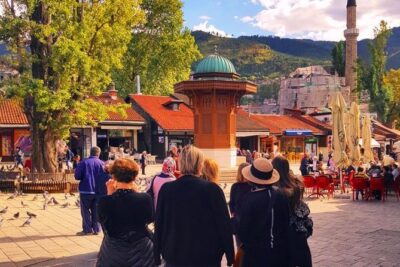
Delicious Sarajevo: Eat, Walk & Discover City Tour
Read our review →
PROFESSIONAL SARAJEVO WALKING TOUR – With guide who guided STING!
Read our review →
Sarajevo genuine walking tour: Steps through history
Read our review →
Browse the lists this tour appears in