
REVIEW · SARAJEVO TOURS
Sarajevo for beginners
Sarajevo reveals its layers quickly. This two-hour walk links mosques, churches, bridges, markets, and the spot where Gavrilo Princip fired the shot that changed Europe. I especially like the three-faith focus and the way the route connects famous sights with small details, such as Bosnian coffee and the meaning of inat. The main drawback is pace: 17 stops in about two hours leaves little time for lingering or entering buildings.
I also like the clear starting point at Trg fra Grge Martića, the English-language format, and the small group limit of 18 people. Guides such as Samra have earned especially warm praise for humor, personal insight, and excellent English. Still, you should treat this as a city orientation walk rather than a full museum tour, since admission fees are not included and most stops are brief.
In This Review
- Five things to know before walking Sarajevo
- Why this is a smart first walk in Sarajevo
- From Sarajevo Cathedral to the Orthodox Church
- Hotel Europe and Tašlihan: two versions of the past
- Bezistan and Bravadžiluk, where commerce becomes culture
- The assassination site and Latin Bridge
- The Emperor’s Mosque, Inat kuća, and the river crossing
- Sarajevo City Hall and the meeting of styles
- Sebilj, Baščaršija, and Sarajevo’s social center
- Morića Han and Gazi Husrev-beg Mosque
- The Jewish Museum and Sarajevo’s shared city story
- What the guides add to the experience
- Pace, group size, and practical limits
- Who should book this Sarajevo walk?
- Should you book Sarajevo for beginners?
- FAQ
- Where does the tour start and finish?
- What time does the tour begin?
- How long does the experience last?
- Is the tour offered in English?
- Is coffee or tea included?
- Are admission tickets included?
- How many people can join the tour?
Five things to know before walking Sarajevo
- The route crosses several centuries: You move from Ottoman markets and mosques to Austro-Hungarian buildings, Orthodox and Catholic churches, Jewish heritage, and the assassination site.
- The pace is brisk: Most stops last five to 15 minutes, so you will hear the main story and then keep moving.
- Coffee is included: The experience includes coffee or tea, a useful introduction to one of Sarajevo’s most familiar daily rituals.
- The group can reach 18 people: That is small enough for a personal feel, though larger than a private walk.
- It ends where it begins: You meet at Trg fra Grge Martića at 9:00 a.m. and return to that same meeting point.
- The value comes from interpretation: With no major admissions included, you are paying mainly for local explanation, storytelling, and a well-planned introduction to the center.
Why this is a smart first walk in Sarajevo
Sarajevo is compact in the center, but it is not simple. Its streets shift from Austro-Hungarian façades to Ottoman lanes within a few minutes. A church may sit near a mosque, a hotel may face the remains of a caravanserai, and a small bridge may carry several names from different periods.
That makes a guided introduction useful. You can walk the same streets alone, but without context, you may miss why a building matters or how the city’s communities lived alongside one another. This route gives you a framework for the rest of your stay.
The tour is especially helpful on your first morning because it covers the central sights without transport. You get a broad sense of Sarajevo’s old core, then you can return later to the places that deserve more time.
The experience is advertised at $34.92 per person. I consider that fair if you want a local guide and an efficient orientation, especially with coffee included. It is less attractive if you mainly want extended interior visits, since admission tickets are not part of the price.
A few more of this kind worth a look:
- Sarajevo: Mostar, Konjic, Blagaj Tekke, Pocitelj & Waterfall
★ 4.9 · 1,335 reviews - Fall of Yugoslavia, Sarajevo War Tour with Tunnel of Hope Museum and Frontlines
★ 5.0 · 1,314 reviews - Sarajevo: Mostar, Konjic, Sufi House, Pocitelj & Kravice Falls
★ 5.0 · 1,179 reviews
From Sarajevo Cathedral to the Orthodox Church
The walk begins at the Cathedral of the Sacred Heart, or Katedrala Srca Isusova. The cathedral is described as simple but beautiful, and that modest character makes it a good opening stop. You get a clear sense of Sarajevo’s Catholic presence without spending much time inside.
The planned visit lasts about 10 minutes. That is enough for an exterior explanation and perhaps a quick look, but not enough for a slow architectural inspection. If the cathedral interests you, note it as a place to revisit after the tour.
The next stop is the Orthodox Church of the Nativity of the Theotokos, a Serbian Orthodox church. Placing these two religious buildings near the start helps explain Sarajevo as a city shaped by several religious traditions.
I appreciate this part of the route because it avoids presenting Sarajevo as only an Ottoman city. You see a more layered picture from the beginning. The short timing also keeps the walk moving toward the old commercial center.
Hotel Europe and Tašlihan: two versions of the past
Hotel Europe introduces the Austro-Hungarian chapter. It is described as Sarajevo’s first hotel and the oldest in Southeast Europe, making it an important landmark for understanding the city’s changing role and architecture.
The stop is only about five minutes, so expect a concise explanation rather than a hotel visit. The building works best as a visual marker of Sarajevo’s move toward modern European urban life.
Nearby, the remains of Tašlihan tell a very different story. Tašlihan was part of the Ottoman commercial world, and what remains today is a reminder that older Sarajevo has often survived in fragments. You will spend about five minutes here.
This pairing is one of the route’s strongest ideas. Hotel Europe and Tašlihan are not just separate sights. Together, they show how different periods occupy the same small section of the city.
Bezistan and Bravadžiluk, where commerce becomes culture
Gazi-Husrev Beg’s Bezistan is introduced as the original shopping mall of Sarajevo. The comparison is useful because it makes an Ottoman commercial building easy to understand. You are not looking at an isolated monument. You are seeing part of a working marketplace tradition.
The planned stop is about five minutes. That is enough to explain the building’s role, but you should not expect a detailed shopping visit or a long architectural study.
The walk also includes the story of Bravadžiluk Street. This matters because street names in Sarajevo often preserve old trades and local habits. The route uses these details to show how commerce shaped the old city.
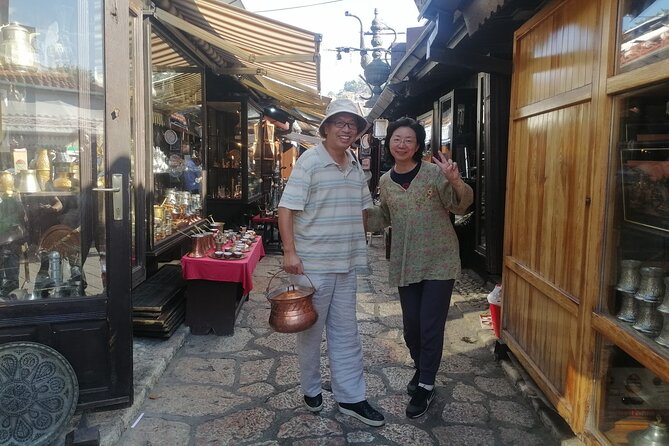
Kazandžiluk, one of Sarajevo’s most authentic streets, receives about 10 minutes. Its name is linked to coppersmithing, and the street helps you picture the craft traditions behind the market district. This is one of the places where the walk feels most connected to everyday Sarajevo rather than only major landmarks.
Something different, still around Sarajevo:
- ROSES OF SARAJEVO (Official WAR + CITY tour)- Story of a Survivor
★ 5.0 · 770 reviews - Sarajevo: Mostar, Konjic, Počitelj, Sufi House, & Waterfalls
★ 4.9 · 572 reviews - Tunnel Museum: Bosnian & Yugoslav Wars Tour with War Veteran
★ 5.0 · 551 reviews - Sarajevo: 2 Hours Old Town Walking Tour With Local Guide
★ 5.0 · 505 reviews
The assassination site and Latin Bridge
The assassination location is given about 15 minutes, the longest stop on the route. This is sensible. The 1914 killing of Archduke Franz Ferdinand and his wife Sophie became the immediate spark for the First World War, and the site demands more than a quick photograph.
Your guide can place the event in its physical setting and explain why this corner became so important. The phrase where the history of the World changed is dramatic, but the point is valid: a local act in Sarajevo had consequences far beyond Bosnia and Herzegovina.
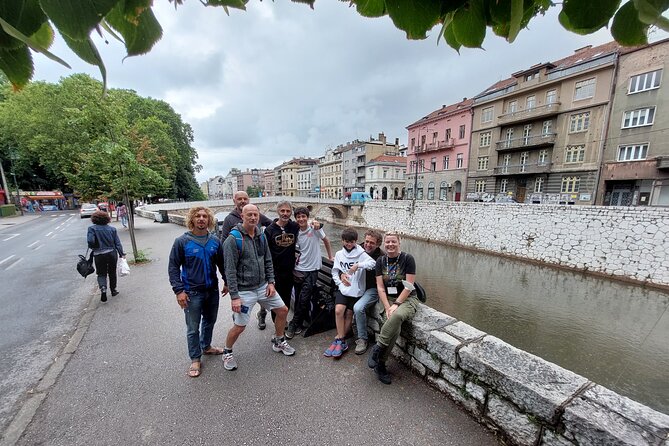
Nearby Latin Bridge is described as the bridge with three names. That detail is a good reminder that places can carry different labels across languages, periods, and political systems. The bridge itself is modest, so the value comes mainly from the explanation around it.
You should expect this section to be serious, but the guides praised for this experience are also known for warmth and humor. That balance matters. Sarajevo’s past includes violence and political trauma, yet a good guide can explain it without turning the entire city into a memorial.
The Emperor’s Mosque, Inat kuća, and the river crossing
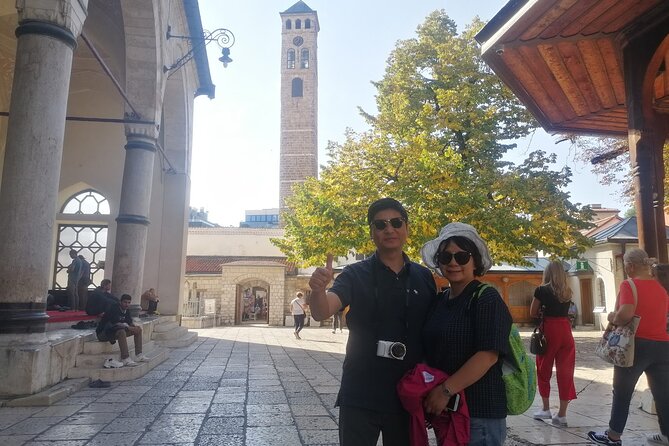
The Emperor’s Mosque is presented as the oldest mosque in Sarajevo. You will have roughly 10 minutes here, enough to learn why it matters within the city’s Ottoman story.
The tour then moves toward Inat kuća, or the House of Spite. This is where you learn what inat means: a stubborn act of defiance, often carried out because someone refuses to be pushed around. Even without a long interior visit, the story gives you a memorable way to understand a local idea.
Seher Cehaja’s Bridge follows. It is described as the oldest bridge in Sarajevo, second built. The wording is a little unclear, so listen closely to the guide’s explanation of the bridge’s construction and history.
These three stops work well together. The mosque represents Ottoman public life, Inat kuća adds a personal and playful character, and the bridge returns you to the Miljacka River and the city’s network of crossings.
Sarajevo City Hall and the meeting of styles
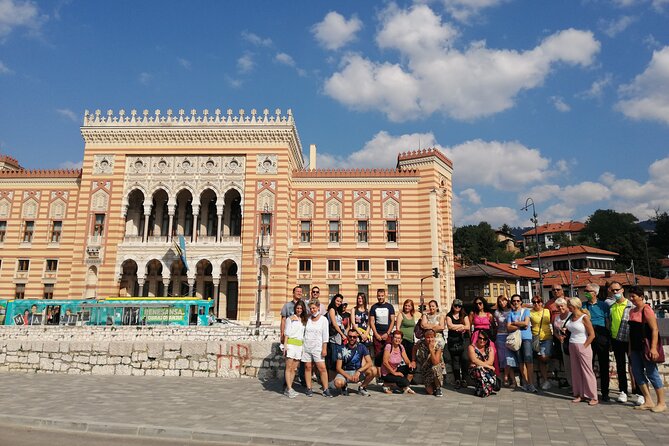
Sarajevo City Hall, or Vijećnica, is one of the major visual highlights. It was built during the Austro-Hungarian period, yet it sits within the old part of town and fits beside Ottoman architecture.
The tour allows about 15 minutes here. That gives you time to take in the exterior and hear how the building fits into Sarajevo’s architectural story. Admission is not included, so this experience does not promise a full interior visit.
I like this stop because it prevents a common mistake: treating Ottoman and Austro-Hungarian Sarajevo as two separate cities. They meet here in a very direct way. The contrast is visible in a single view, which makes the city easier to read as you continue walking.
If you later choose to pay for an interior visit, you will already have useful context. If you do not, the exterior explanation still earns its place on the route.
Sebilj, Baščaršija, and Sarajevo’s social center
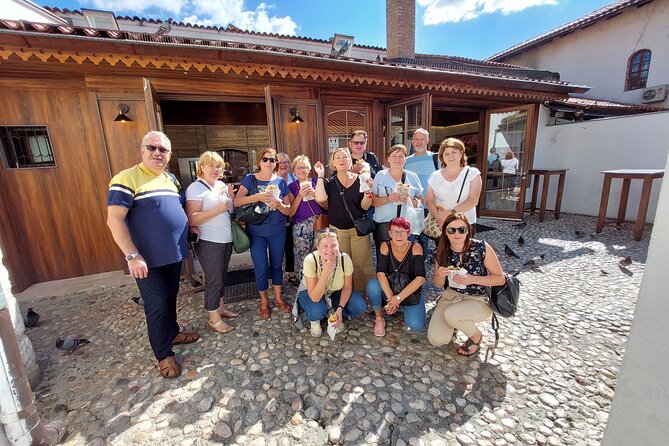
Sebilj is a classic meeting place in the old market area. The stop lasts about five minutes, but it gives you a useful orientation before entering Baščaršija, Sarajevo’s main square.
Baščaršija is where the walk’s many themes gather. Ottoman commerce, food, craft streets, religious buildings, cafés, and public life all meet here. You will spend around 10 minutes, though the square deserves more time on your own.
This is the point where I would mentally mark several return stops. You may want to come back for a slower walk, a meal, shopping, or another look at the details you missed while keeping up with the group.
The experience does not promise a meal, and coffee or tea is the included refreshment. That makes the coffee stop particularly useful. You get a small taste of local café culture without having to plan a separate activity during the tour.
Morića Han and Gazi Husrev-beg Mosque
Fotokopirnica Morića Han is called probably the coolest place in Sarajevo. The name may sound like a copy shop, but the stop is tied to Morića Han, a historic inn in the old market district. The tour gives it about 10 minutes.
This is an example of the route’s appeal. It does not focus only on the biggest monuments. It also points you toward places with character, where the story of old Sarajevo feels close and approachable.
Gazi Husrev-beg Mosque receives another 10-minute stop. It is described as the central mosque in Sarajevo and is one of the key Ottoman landmarks in the city center.
As with the other religious buildings, admission is not included. Dress and entry arrangements are not specified, so you should follow the guide’s instructions and allow time to return later if you want a more complete visit.
The route’s phrase different time, different story fits this section well. Every few minutes, the city changes its voice. The mosque, market, inn, church, hotel, and bridge are close together, but they point to different chapters.
The Jewish Museum and Sarajevo’s shared city story
The final named stop is the Jewish Museum of Bosnia and Herzegovina, in a square where you hear about Jewish life in Bosnia and Herzegovina. The stop lasts about 15 minutes.
This is an important ending because it completes the religious and cultural picture begun at the Catholic cathedral and Orthodox church. Sarajevo’s story cannot be reduced to one community or one empire. The Jewish Museum adds another essential part of the city’s identity.
Admission is not included, so the route gives you an introduction rather than a guaranteed museum visit. If this subject matters to you, ask the guide how to return for a longer look after the walk.
Ending with this story gives the experience a wider purpose. You have not simply collected photographs. You have seen how different communities, political systems, and traditions shaped the same central streets.
What the guides add to the experience
The strongest praise for this experience centers on the guides, particularly Samra. She is described as warm, funny, direct, and able to answer difficult questions while offering a personal perspective on Bosnia and Herzegovina.
That combination is valuable in Sarajevo. The facts are important, but so are tone and judgment. You want a guide who can explain war, religion, empire, and local customs without flattening the city into a series of slogans.
I would not assume Samra will lead every departure, since the assigned guide is not specified. Irfan is also named as an informative and friendly guide associated with Cooltour Sarajevo. The consistent strength appears to be the company’s English-language guiding, but individual styles can vary.
A practical tip is to ask about Bosnian coffee during the experience. One past participant specifically credited the guide with teaching the proper way to drink it, along with offering advice about other places to visit. That kind of small instruction can make the tour useful beyond its official stops.
Pace, group size, and practical limits
The walk starts at 9:00 a.m. at Trg fra Grge Martića and returns there. It is offered in English, uses a mobile ticket, and allows service animals. The meeting point is near public transportation, and most people can participate.
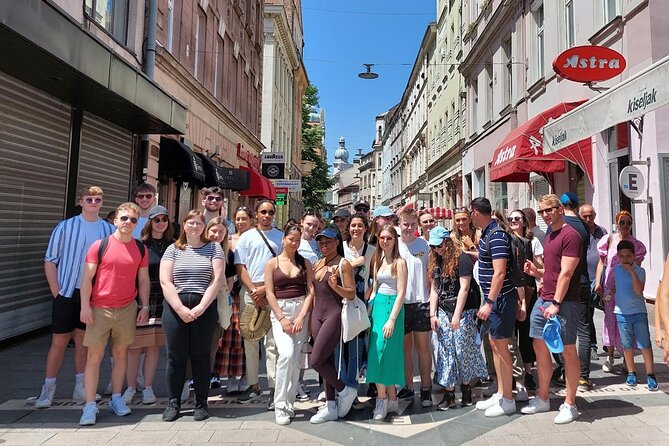
The group limit is 18. That is a reasonable size for a walking tour, though you may not receive the same easy access to the guide as you would on a private walk. If you have a question, ask it early rather than waiting until the end.
The listed timing adds up to many short visits, so the two-hour estimate should be understood as a brisk overview. Some stops are likely orientation points rather than full visits. Wear comfortable shoes, keep your phone ready for photographs, and avoid packing the morning with another fixed activity immediately afterward.
The tour requires a minimum number of participants. If that minimum is not met and the experience is canceled, you are offered another date or experience, or a full refund. You can cancel for a full refund up to 24 hours before the start time. Changes or cancellations inside that window are not accepted.
Who should book this Sarajevo walk?
I would choose this experience if you are visiting Sarajevo for the first time, want a structured introduction, or prefer learning from a local guide rather than reading signs on your own. It is also useful for anyone interested in how Ottoman, Austro-Hungarian, Catholic, Orthodox, Muslim, and Jewish stories overlap in one center.
It suits solo visitors and couples particularly well because the price is moderate and the group format makes it easy to get oriented. A larger group can also benefit, especially if you want one person to organize the historical sequence.
I would hesitate if you dislike brisk walking, want long museum visits, or prefer a private itinerary. The stops are numerous, the admissions are extra, and the tour cannot give every building the time it deserves.
Should you book Sarajevo for beginners?
Yes, if you want a lively two-hour foundation for the city. The value is not in included admissions or extensive time at each monument. It is in the route, the local interpretation, the coffee, and the connections between places that might otherwise seem unrelated.
Book it early in your stay, then use the guide’s suggestions to decide where to return. At $34.92, it is a sensible buy for first-time visitors who want Sarajevo to make sense quickly. Skip it only if you already know the old center well or want a slower, more specialized history walk.
FAQ
Where does the tour start and finish?
It starts at Trg fra Grge Martića in Sarajevo and ends back at the same meeting point.
What time does the tour begin?
The stated start time is 9:00 a.m.
How long does the experience last?
The tour lasts approximately two hours.
Is the tour offered in English?
Yes. English is the stated language.
Is coffee or tea included?
Yes. Coffee and/or tea is included in the experience.
Are admission tickets included?
No. Admission tickets are not included for the listed stops.
How many people can join the tour?
The maximum group size is 18 people.
Just added around Sarajevo
- Srebrenica Genocide Tour from Sarajevo★ 4.5 · 3 reviews
- Mountain Village Lukomir Full Day Adventure Tour★ 5.0 · 3 reviews
- MTB Bjelasnica – Lukomir★ 5.0 · 3 reviews
- Sarajevo Under Siege: A City’s Struggle & Survival Tour★ 5.0 · 3 reviews
- Herzegovina Tour from Sarajevo: Mostar, Počitelj, Blagaj, Kravice★ 5.0 · 3 reviews
- Beautiful Bosnia 8 Days Tour Package★ 5.0 · 3 reviews
- Bosnian Kingdom Capitals: Travnik & Jajce Tour from Sarajevo★ 5.0 · 3 reviews
- Walking Tour in Sarajevo★ 5.0 · 3 reviews
Sarajevo Tours, compared.
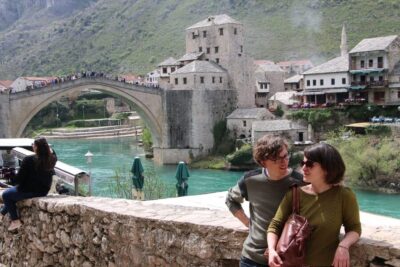
Mostar, Konjic, Blagaj Tekke, Pocitelj & Waterfall
Read our review →
Fall of Yugoslavia, Sarajevo War Tour with Tunnel of Hope Museum and Frontlines
Read our review →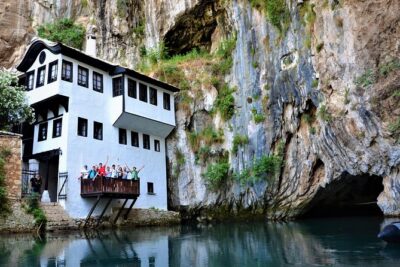
Mostar, Konjic, Sufi House, Pocitelj & Kravice Falls
Read our review →
ROSES OF SARAJEVO (Official WAR + CITY tour)- Story of a Survivor
Read our review →
Mostar, Konjic, Počitelj, Sufi House, & Waterfalls
Read our review →
Tunnel Museum: Bosnian & Yugoslav Wars Tour with War Veteran
Read our review →
Mostar, Konjic, Dervish House, Pocitelj & Kravica Falls
Read our review →Browse the lists this tour appears in