
REVIEW · BOSNIAN WAR HISTORY TOURS
Sarajevo: A City Under Siege – War Tour With Tunnel Museum
Sarajevo’s hills still carry the scars of war. This three to four-hour tour links the Tunnel of Hope, Sniper Alley, an old Jewish cemetery, the abandoned Olympic track, and a fine city viewpoint. I like the way it connects places that can feel scattered when explored alone, and I like that an English-speaking guide helps explain what you are seeing rather than leaving you with a string of bare facts. The main consideration is the extra €10.50 entrance fee for the Tunnel Museum, which is not included in the $40.81 tour price.
The experience also includes an air-conditioned vehicle, bottled water, and a maximum group size of 15. Guides such as Edis and Elvis have been praised for clear explanations, warmth, and their ability to connect wartime events with life in modern Sarajevo. You should expect a serious, sometimes painful subject, balanced by striking views and a few unusual stops.
In This Review
- Key points to know before you go
- Why this Sarajevo tour works so well
- Entering the Tunnel of Hope
- Seeing Sniper Alley with a guide
- The Jewish Cemetery above the city
- The Olympic bobsleigh track on Trebevic
- A final view from the Yellow Fortress
- What the $40.81 price really covers
- Timing, meeting point, and group size
- How to prepare for a serious but rewarding afternoon
- Who will get the most from this experience?
- Should you book Sarajevo’s War Tour?
- FAQ
- How much does the tour cost?
- How long does the experience last?
- What time does the tour begin?
- Where does the tour start?
- Where does the tour end?
- What is included in the price?
- Is the Tunnel Museum admission included?
- How many people can join the tour?
Key points to know before you go
- The Tunnel of Hope anchors the tour: You pay an additional €10.50 to enter the museum, but this is the essential stop for understanding Sarajevo’s siege.
- Sniper Alley is seen in context: The tour shows you the dangerous route through the city and explains why it mattered during the war.
- The Jewish Cemetery has two stories: It is both one of the oldest Jewish cemeteries in southeastern Europe and a wartime sniper position.
- The Olympic bobsleigh track has a stark setting: The 1984 venue later sat on the frontline and is now marked by graffiti.
- Yellow Fortress gives you the best visual pause: The short stop above City Hall provides a wide view over Sarajevo.
- The price includes transport and water: You pay $40.81 per person, plus the separate Tunnel Museum entry fee.
Why this Sarajevo tour works so well
Sarajevo is a city where geography explains much of the recent past. The surrounding hills rise sharply above the old center, and that physical shape helps you understand why the siege was so frightening. From high ground, you can see how exposed the city was.
I like this tour because it does not stay in one museum. You move through the city and up toward Trebevic, seeing a cemetery, a road, an Olympic site, and a fortress along the way. Each stop gives you a different piece of the story.
The guide matters here. A good explanation can turn a road junction into a place you remember, and it can help you understand how ordinary movement became dangerous during the siege. The strongest feedback about this experience focuses on the guides’ ability to explain both the war and modern Sarajevo. Edis and Elvis are named as especially effective guides, with praise for their communication, sympathy, and broad knowledge of the city.
This is not a light sightseeing ride. The subject includes civilians under threat, sniper positions, survival, and the destruction caused by the Bosnian war. You will get more from it if you give the serious parts your full attention.
More war history tours:
- Fall of Yugoslavia, Sarajevo War Tour with Tunnel of Hope Museum and Frontlines
★ 5.0 · 1,314 reviews - ROSES OF SARAJEVO (Official WAR + CITY tour)- Story of a Survivor
★ 5.0 · 770 reviews - Tunnel Museum: Bosnian & Yugoslav Wars Tour with War Veteran
★ 5.0 · 551 reviews
Entering the Tunnel of Hope
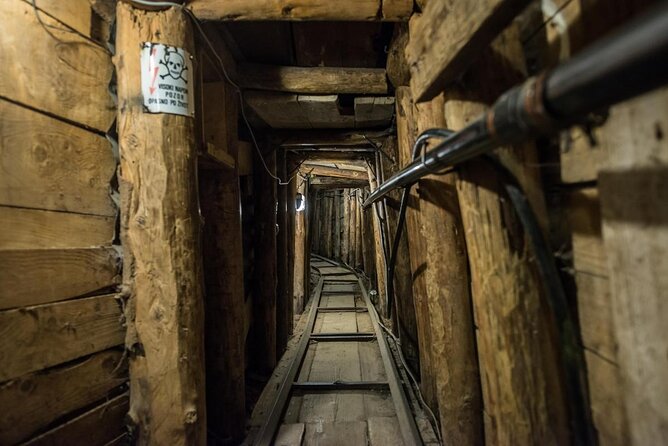
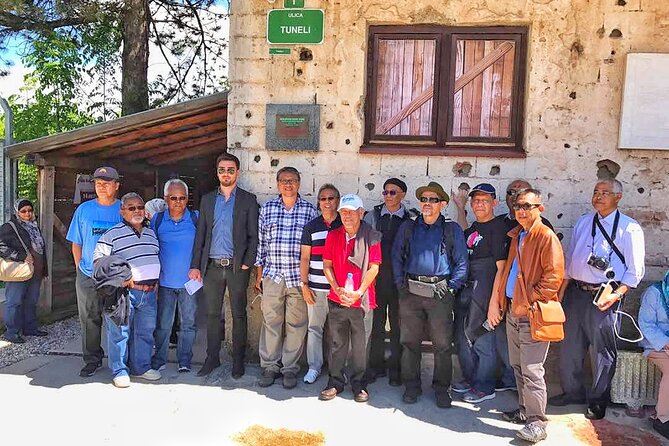
The Sarajevo War Tunnel, also called the Tunnel of Hope or DB War Tunnel, is the tour’s central stop. Allow about an hour here. The tunnel tells the story of resistance and survival during the siege of Sarajevo, described as the longest siege in modern history.
The museum entrance costs €10.50 per person, paid separately. That extra charge is important when you compare the total cost with the advertised $40.81. Still, I consider the tunnel fee reasonable because this is the one stop where the subject becomes physical. You are not only hearing about restricted movement and supply problems. You are seeing the place built to help Sarajevo endure.
The tunnel visit gives the tour its emotional weight. The other stops show locations connected to the war, but this one explains the practical struggle to keep the city alive. The name Tunnel of Hope is not decorative. It reflects what the passage meant to people trying to survive.
The exact amount of tunnel you can enter is not specified, so you should not book this expecting a long underground walk. The important value comes from the museum setting, the guide’s explanation, and the role of the tunnel in the city’s wartime story.
One hour is a useful amount of time, though the subject can feel dense. Listen closely to the guide, and leave room afterward to take in the other stops. This is the point where many visitors may need a quiet moment before moving on.
Seeing Sniper Alley with a guide
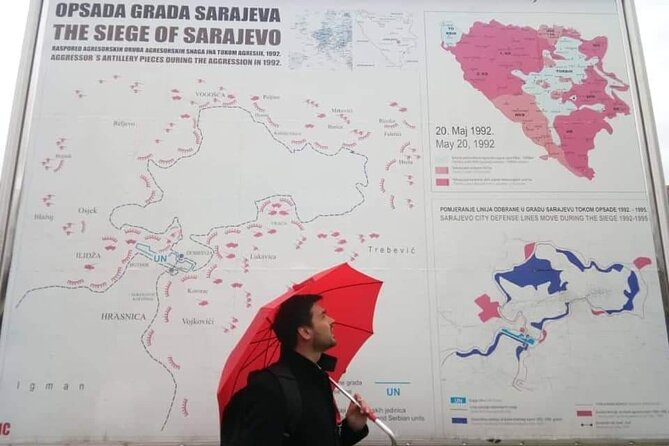
Sniper Alley is scheduled for about 30 minutes, with no separate admission fee. During the siege, it was considered the most dangerous area to cross in Sarajevo.
On your own, you might pass through the area without knowing what you are looking at. With a guide, the road becomes part of a larger explanation about danger, movement, and the way the city functioned under attack. That is one of the tour’s practical strengths: it gives meaning to places that do not look like conventional attractions.
Do not expect a formal museum installation here. This is a location-based stop, and its value comes from the setting and the explanation. The visit is brief, but the point is clear. Sarajevo’s streets were not simply routes between neighborhoods. Some became exposed corridors where crossing could carry terrible risk.
The guide’s role is especially important at Sniper Alley. The praise for Edis and Elvis focuses on their ability to explain what happened and what life in Sarajevo is like now. That balance matters. You are not left with a frozen picture of wartime Sarajevo, but you also are not rushed past the pain of the past.
The Jewish Cemetery above the city
The Jewish Cemetery receives about 30 minutes and has no admission charge. It is one of the oldest Jewish cemeteries in southeastern Europe, but during the Bosnian war it also served as a sniper nest.
That contrast makes the stop unusually powerful. A cemetery is already a place of memory, and the wartime use adds another layer to its meaning. You are looking at a site with religious and cultural importance that was also drawn into the conflict.
This is a good example of why a guided tour helps. Without context, you might see an old cemetery and move on. The explanation shows how Sarajevo’s past is not divided into neat sections. Jewish heritage, Ottoman-era city life, the 1984 Winter Olympics, and the Bosnian war all belong to the same city.
The stop is short enough to fit comfortably into the day, but you should treat it with respect. It is not simply a viewpoint or photo stop. The location carries both historical and human significance.
More museums and galleries:
- Tunnel of Hope Museum Tour
★ 5.0 · 38 reviews - Cable Car Olympic Tour With Museum
★ 5.0 · 17 reviews - SARAJEVO CONCEPTUAL ART TOUR (galleries, art and arhitecture)
★ 5.0 · 7 reviews
The Olympic bobsleigh track on Trebevic
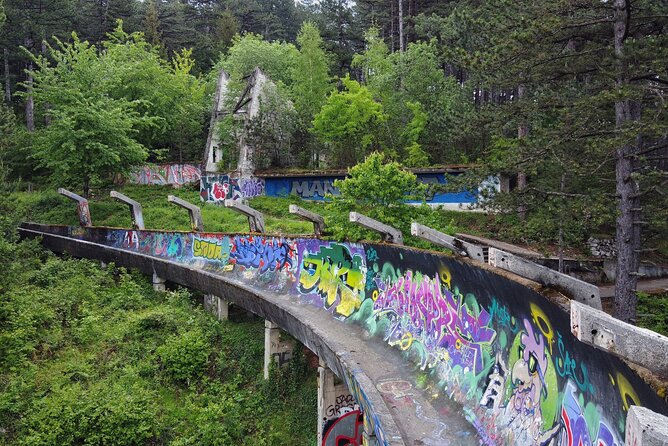
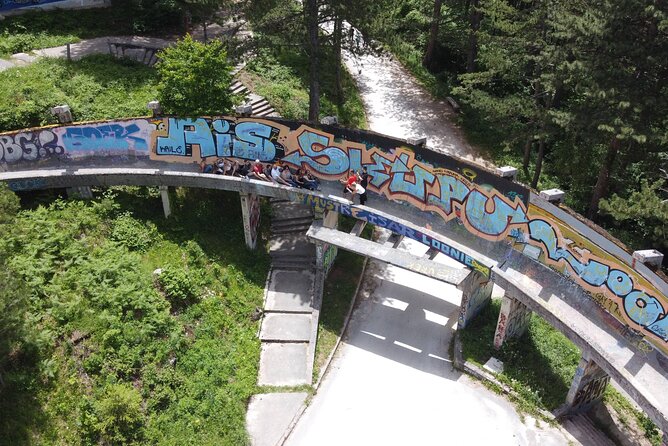
The Sarajevo Olympic bobsleigh and luge track is scheduled for about an hour. It was part of the 1984 Winter Olympics and later sat on the frontline during the war. Today, it is an abandoned site covered with graffiti.
This is one of the tour’s most unusual stops. The Olympic connection gives you a glimpse of Sarajevo before the war, when the city hosted an international sporting event. The damaged, abandoned setting then shows how sharply the city’s story changed.
The track is located above the Old Town on Mount Trebevic. That position also gives the stop a strong visual quality. You are not visiting a polished sports venue. You are seeing a place where Olympic ambition, wartime destruction, abandonment, and modern street art now meet.
Allowing an hour gives you more than a quick look. You can take in the structure, the graffiti, and the setting while the guide explains why the site matters. The tour description calls it one of the most beautiful abandoned sights from the 1984 Olympics, but beauty here comes with an edge. The place is striking partly because it is no longer being used for its original purpose.
The main drawback is that abandoned sites can feel less predictable than formal attractions. The supplied details do not specify the exact walking surface or conditions, so sensible shoes are a good idea. That is practical advice rather than a promise about the site, but it is worth keeping in mind for a stop on a mountain.
A final view from the Yellow Fortress
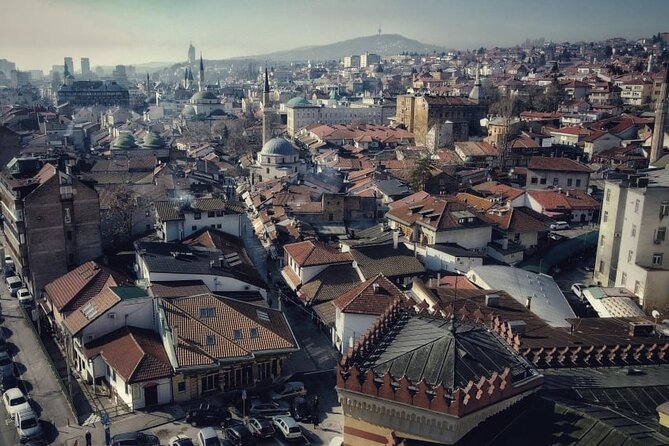
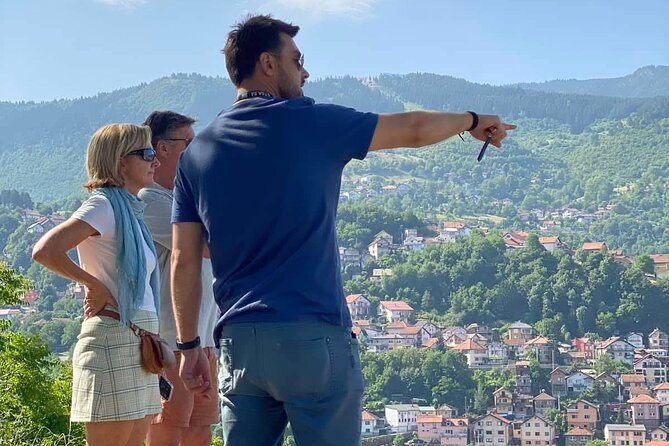
The Yellow Fortress is a short 15-minute stop above City Hall. It is described as the most beautiful panoramic spot on the route.
This is the tour’s visual reset after the heavier wartime locations. From above, you can look across Sarajevo and get your bearings. The city’s position among the hills becomes easier to understand, and the viewpoint helps connect the places you have seen during the day.
Fifteen minutes is enough for a quick explanation and photographs, but it is not a long sightseeing session. If you want extended time at the viewpoint, this tour may feel rushed. The stop works best as a final pause rather than a full visit.
I like that the panoramic stop comes after the war-related sites. You first learn what the city endured, then look across the city as it exists now. The view does not erase the difficult material, but it gives the experience a calmer ending.
What the $40.81 price really covers
The listed price is $40.81 per person. For that amount, you receive an air-conditioned vehicle, bottled water, and an English-speaking guide. The group can include up to 15 people, which is small enough for a more personal explanation without being a private tour.
The Tunnel Museum entry is extra at €10.50 per person. Tips are also not included. In practical terms, you should budget for the tour price, the museum fee, and an optional tip if the guide provides a strong experience.
I think the price offers fair value if you want several outlying sites covered in one half-day. The vehicle matters because the route includes locations above the city and on Trebevic. You avoid piecing together separate transport, and you get a guide to explain why each place matters.
The value depends on your interests. If you only want Sarajevo’s Old Town and major central sights, this tour may feel too focused on twentieth-century conflict. If you want to understand the siege and see places that are difficult to interpret alone, the combination of transport and guiding makes the cost easier to justify.
The included bottled water is a small but welcome touch. The air-conditioned vehicle is also useful, though the tour’s exact vehicle time and walking requirements are not specified. The experience lasts about three to four hours, with the individual stops adding up to roughly three hours before allowing for driving and transitions.
Timing, meeting point, and group size
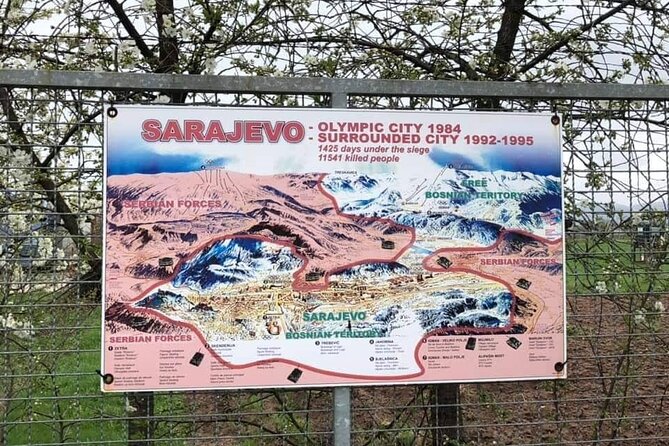
The tour starts at 12:00 pm from House of Spite, at Veliki Alifakovac 1 in Sarajevo. It ends back at the same meeting point. That central start and finish make it easier to fit the experience into a day of sightseeing, though you should plan to arrive with time to spare.
A noon departure means your morning remains free. You could use it for the Old Town before meeting the guide, then spend the afternoon continuing elsewhere after the tour. Since the experience ends where it begins, you do not need to arrange a separate return transfer.
The maximum group size is 15 people. That is not the same as a private outing, but it should allow the guide to speak to the group without the scale of a large coach trip. The English-language format makes it suitable for English-speaking visitors.
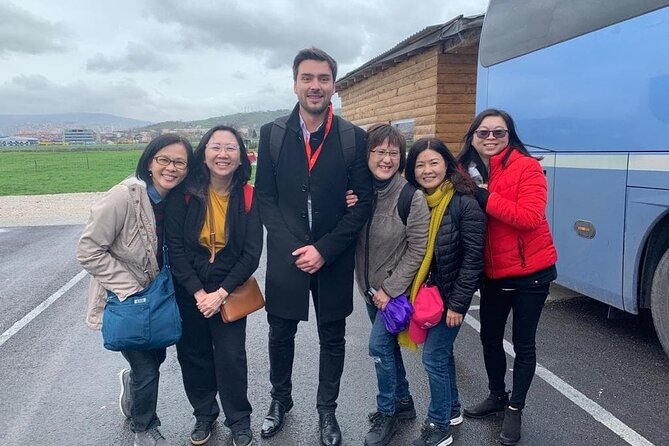
Mobile tickets are provided, and confirmation comes at booking. The tour is near public transportation, and most people can participate. The information does not give detailed accessibility notes, so anyone with specific mobility needs should confirm conditions before booking, especially for the cemetery and Olympic track stops.
How to prepare for a serious but rewarding afternoon
The best preparation is mental. This is a war tour, not a standard city highlights trip. The Tunnel of Hope, Sniper Alley, and the cemetery all require a respectful attitude.
Wear practical shoes, particularly because the route includes the bobsleigh and luge track on Trebevic. The exact walking conditions are not stated, so you should avoid assuming that every stop will have smooth, level paths.
Bring a little extra money for the €10.50 Tunnel Museum entry. Since tips are excluded, you can also plan for one if you feel the guide has helped you understand the city. Guides such as Edis and Elvis have been praised for sympathy, communication, and their ability to explain modern Sarajevo alongside the war years.
You should also leave emotional space in your schedule. The experience moves through several sites, but the subject is not easy entertainment. The final view from Yellow Fortress helps lighten the mood, yet the central message remains one of survival and loss.
Who will get the most from this experience?
I would recommend this tour to you if you want more than attractive streets and historic buildings. It suits anyone interested in the Bosnian war, Sarajevo’s siege, modern European history, or the way a city’s geography shapes its past.
It is also a good choice if you prefer a guide-led experience. The stops are spread across different parts of Sarajevo, and several would be hard to interpret without explanation. The English-speaking guide is not just a driver. The guide is the link between the physical site and the story behind it.
You may find it less suitable if you want a relaxed scenic drive with only light historical commentary. The tunnel and sniper-related stops are serious, and the tour does not soften the subject. Families and older visitors may participate, since most people can take part, but each person should decide if the wartime material is appropriate for them.
The tour also suits a first visit because it offers a clear introduction to Sarajevo’s recent past. If you already know the siege in detail, you may prefer a more specialized museum visit. Even then, the combination of sites and the Olympic track could add useful place-based context.
Should you book Sarajevo’s War Tour?
Book it if you want a well-organized way to understand Sarajevo’s siege and see the places that shaped that story. The strongest reasons are the Tunnel of Hope, the varied route, the small maximum group size, and the guides’ praised ability to explain both wartime events and present-day life.
Before booking, remember the total cost is higher than $40.81 because the Tunnel Museum charges an additional €10.50. Also expect a serious afternoon, not a casual sightseeing loop.
If you can give the subject your attention, I think this tour is a strong use of three to four hours in Sarajevo. It shows you the city through places of survival, danger, memory, sport, and renewal, then sends you back to the meeting point with a clearer sense of what Sarajevo endured.
FAQ
How much does the tour cost?
The tour costs $40.81 per person. The Tunnel Museum entrance fee of €10.50 per person is not included.
How long does the experience last?
The tour lasts approximately three to four hours.
What time does the tour begin?
The start time is 12:00 pm.
Where does the tour start?
The meeting point is House of Spite, Veliki Alifakovac 1, Sarajevo 71000, Bosnia and Herzegovina.
Where does the tour end?
The tour ends back at the meeting point.
What is included in the price?
The price includes an air-conditioned vehicle, bottled water, and an English-speaking guide.
Is the Tunnel Museum admission included?
No. Admission to the Tunnel Museum costs €10.50 per person and must be paid separately.
How many people can join the tour?
The tour has a maximum group size of 15 people.
Just added around Sarajevo
- Srebrenica Genocide Tour from Sarajevo★ 4.5 · 3 reviews
- Mountain Village Lukomir Full Day Adventure Tour★ 5.0 · 3 reviews
- MTB Bjelasnica – Lukomir★ 5.0 · 3 reviews
- Sarajevo Under Siege: A City’s Struggle & Survival Tour★ 5.0 · 3 reviews
- Herzegovina Tour from Sarajevo: Mostar, Počitelj, Blagaj, Kravice★ 5.0 · 3 reviews
- Bosnian Kingdom Capitals: Travnik & Jajce Tour from Sarajevo★ 5.0 · 3 reviews
- Beautiful Bosnia 8 Days Tour Package★ 5.0 · 3 reviews
- Walking Tour in Sarajevo★ 5.0 · 3 reviews
Bosnian War History Tours, compared.

Fall of Yugoslavia, Sarajevo War Tour with Tunnel of Hope Museum and Frontlines
Read our review →
ROSES OF SARAJEVO (Official WAR + CITY tour)- Story of a Survivor
Read our review →
Tunnel Museum: Bosnian & Yugoslav Wars Tour with War Veteran
Read our review →
Sarajevo War Tour: A Veteran’s Story of the Siege (fees included)
Read our review →
Break-up of Yugoslavia & The War in Mostar: Life Under Siege
Read our review →
Sarajevo Grand Tour: Old Town, War Tunnel, Olympic Sites & More
Read our review →Browse the lists this tour appears in